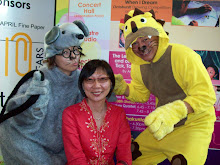
Most of the time positive thought generate a steady and creative influence on us at work.
We might gain success if we channel our creativity into working well under pressure.
Occassionally, petty disputes may arise with people, so be sure you don't say anything that will add fuel to the fire.
When you are depressed or your mood is low, spend some quiet time reading a humorous book or watch a funny movie to cheer yourself up.
Alternatively, do some exercise, or just walk away and you may change your focus and recharged yourself!
Dexterine Ho Soo Miang
Monday, April 30, 2012


On Employment
Employment gives health, sobriety, and morals.
Constant employment and well-paid labor produce general prosperity, content, and cheerfulness.
-- Daniel Webster
Constant employment and well-paid labor produce general prosperity, content, and cheerfulness.
-- Daniel Webster
Saturday, April 28, 2012
Learning and teaching ...
The mediocre teacher tells.
The good teacher explains.
The superior teacher demonstrates.
The great teacher inspires.
-- William Arthur Ward
When I conduct training, I like to share the ideas of learning the reference points instead of learning the fact and remembering them.
I think it is through telling, explaining and demonstrating that we transfer our learning and knowledge on certain subject matter, which is limited in range.
If we can lead them to learn by "referring" to the pool of knowledge with good indexing tools or reference points, the power of learning will be endless.
With the "reference learning method", one can expands on the knowledge domain and boarder one's zone of understanding.
Do not be afraid that you cannot remember all the facts and details, no one does.
If you know where to get and verify the facts and details when you need them, you will have no problem of creating your knowledge domain in the long run.
Dexterine Ho Soo Miang
The good teacher explains.
The superior teacher demonstrates.
The great teacher inspires.
-- William Arthur Ward
When I conduct training, I like to share the ideas of learning the reference points instead of learning the fact and remembering them.
I think it is through telling, explaining and demonstrating that we transfer our learning and knowledge on certain subject matter, which is limited in range.
If we can lead them to learn by "referring" to the pool of knowledge with good indexing tools or reference points, the power of learning will be endless.
With the "reference learning method", one can expands on the knowledge domain and boarder one's zone of understanding.
Do not be afraid that you cannot remember all the facts and details, no one does.
If you know where to get and verify the facts and details when you need them, you will have no problem of creating your knowledge domain in the long run.
Dexterine Ho Soo Miang
Friday, April 27, 2012
Two roads diverged ...
Two roads diverged in a wood, and I - I took the one less traveled
by, And that has made all the difference.
-- Robert Frost (1875-1963) American Poet
by, And that has made all the difference.
-- Robert Frost (1875-1963) American Poet
I learnt the quotation when I was in university and like it very much. I think it is good to take a road less traveled as it gives you a chance for new discovery!
研究遺憾: 歷史學
「歷史學就是研究遺憾的一門學科,它專門來發現總結:原來人們可以這樣做,不是那樣做。所以歷史學家研究這麼多遺憾,他常有扼腕之痛。」
上海大學歷史系朱學勤教授談及辛亥革命時如此說!
Source of information:
鏗鏘集 百年一願
鏗鏘集 百年一願
Thursday, April 26, 2012
MARC tag 550 and 710
After doing assessment today, I just like to share some points on use of MARC tage 550 and 710 for a serial entry:
I search "British Economic Society) and found the:
The economic journal : the quarterly journal of the Royal Economic Society.
In the MARC record:
As some candidates who are doing serials cataloguing will experience change of publishers and it is good to note the use of MARC tag 550 to add the notes and create MARC tag 710 for added entry.
Some other good reference pointers from the folloing ppt maybe of interest to some readers:
Tuesday, April 24, 2012
OCLC Bibliographic Formats and Standards
OCLC Bibliographic Formats and Standards
http://www.oclc.org/bibformats/en/
Bibliographic Formats and Standards is a guide to machine-readable cataloging records in WorldCat. It provides tagging conventions, input standards and guidelines for entering information into WorldCat.
Biblographic Formats and Standards assumes you are familiar with Anglo-American Cataloguing Rules, second edition, 2004 Revision, and other standard cataloging reference material. Some sections also assume you have a general knowledge of data processing and databases.
http://www.oclc.org/bibformats/en/
Bibliographic Formats and Standards is a guide to machine-readable cataloging records in WorldCat. It provides tagging conventions, input standards and guidelines for entering information into WorldCat.
Biblographic Formats and Standards assumes you are familiar with Anglo-American Cataloguing Rules, second edition, 2004 Revision, and other standard cataloging reference material. Some sections also assume you have a general knowledge of data processing and databases.
It provides all the Marc tags explanation, e.g., 0xx to 9xx fields in PDF files
Source of information:
http://www.oclc.org/bibformats/en/
Understanding MARC
Understanding MARC Bibliographic: Machine-Readable Cataloging
http://www.loc.gov/marc/umb/
The information on this web site is written by Betty Furrie in conjunction with the Data Base Development Department of The Follett Software Company Eighth edition reviewed and edited by the Network Development and MARC Standards Office, Library of Congress
Published by the Cataloging Distribution Service, Library of Congress, in collaboration with The Follett Software Company
Source of information:
http://www.loc.gov/marc/umb/
http://www.loc.gov/marc/umb/
The information on this web site is written by Betty Furrie in conjunction with the Data Base Development Department of The Follett Software Company Eighth edition reviewed and edited by the Network Development and MARC Standards Office, Library of Congress
Published by the Cataloging Distribution Service, Library of Congress, in collaboration with The Follett Software Company
Source of information:
http://www.loc.gov/marc/umb/
- What is a MARC Record, and Why is it Important?
- Part I: What Does MARC Mean?
Part II: Why Is a MARC Record Necessary?
Part III: MARC Terms and Their Definitions
Part IV: Where do MARC Records Originate?
Part V: MARC Data Issues
Part VI: In Conclusion - MARC 21 Reference Materials -- Parts VII to X
- Part VII: A Summary of Commonly Used MARC 21 Fields
Part VIII: A List of Other Fields Often Seen in MARC Records
Part IX: The Leader
Part X: Field 008 for Books - MARC 21 Reference Materials -- Parts XI to XII
- Part XI: A Sample Record in Various Formats
Part XII: AV Records: From Cards to MARC 21
Selected Bibliography
MARC 21 Content Designators: A Review
Tuesday, April 17, 2012
RDA & AACR2: What's the Difference?
"RDA is the new cataloging standard developed to replace AACR2. Susan Wynne from the University of Wyoming will examine the major differences, view RDA records, discuss the status of implementation plans in U.S. libraries, and consider RDA's possible effects on catalogers, public services, and users."
Source of information:
RDA & AACR2: What's the Difference?
http://www.youtube.com/watch?v=QkBpC0ALwwo
Source of information:
RDA & AACR2: What's the Difference?
http://www.youtube.com/watch?v=QkBpC0ALwwo
RDA Changes from AACR2 for Texts
"As the United States begins to prepare to test the new cataloging code, RDA: Resource Description and Access, this presentation explores the changes from AACR2 (Anglo-American Cataloguing Rules, 2nd ed.) that the new code brings. The focus of this presentation is a brief overview of the changed instructions for cataloging textual materials. The presentation lasts 41 minutes, and the Q&A session afterward runs 35 minutes.
Speaker Biography: Barbara Tillett is chief of the Policy and Standards Division, Acquisitions and Bibliographic Access Directorate at the Library of Congress."
Speaker Biography: Barbara Tillett is chief of the Policy and Standards Division, Acquisitions and Bibliographic Access Directorate at the Library of Congress."
Source of information:
RDA Changes from AACR2 for Texts
http://www.youtube.com/watch?v=DzWGIMqbw-U
Friday, April 13, 2012
What Makes a Librarian
This was the first of a series of discussions that LAS planned for librarians, so that we can had dialogue on issues close to our hearts.
“What Makes a Librarian?”
Date: Friday, 13 Apr 2012
Time: 6:00-8:30pm
Venue: The Pod, National Library Building
*************************************************************************
What Makes a Librarian?
CEO NLB Mrs Elaine Ng shared her views on the qualities that distinguish librarians from other professions. I think I agreed with her that the way recorded information moved from printed source and toward interactive mode on Internet via Social Media, and the primary learning method shifted from printed text to media mode or interactive mode is something challenging the Librarian in the future!
Mr Choy Fatt Cheong shared from CISPIN (Committee on Information Studies Programmes and Industry Needs) report the views on the attributes and competencies of a library and information professional.
Mr Gene Tan, President LAS, shared his experience at the PPM/LAS confernenc in Malacca, and the opportunities for professional growth and development through Singapore hosting of the World Library and Information Congress by IFLA in 2013. The Singapore Memory Project
We will also take the opportunity to recognise our fellow professionals who have been certified under the Professional Development Scheme.
Beside the senior librarians from NLB, Academic Libraries and other libriaries, many young librarians also shared their views on "What you think makes a librarian?" – a critical and yet ageless question for our profession.
I enjoy an evening of networking and discussions with fellow librarians and info professionals:
6:00pm Registration and Networking (please be seated by 6:30pm)
6:30pm Opening by emcee
6:35pm Opening speech by GOH, Mrs Elaine Ng, NLB CEO
6:45pm Presentation of LAS PDS certs
6:55pm Speech by Mr Choy Fatt Cheong, University Librarian, NTU
7:10pm Audience discussion
7:40pm Speech by Mr Gene Tan, LAS President
7:55pm Lucky draw

“What Makes a Librarian?”
Date: Friday, 13 Apr 2012
Time: 6:00-8:30pm
Venue: The Pod, National Library Building
*************************************************************************
What Makes a Librarian?
CEO NLB Mrs Elaine Ng shared her views on the qualities that distinguish librarians from other professions. I think I agreed with her that the way recorded information moved from printed source and toward interactive mode on Internet via Social Media, and the primary learning method shifted from printed text to media mode or interactive mode is something challenging the Librarian in the future!
Mr Choy Fatt Cheong shared from CISPIN (Committee on Information Studies Programmes and Industry Needs) report the views on the attributes and competencies of a library and information professional.
Mr Gene Tan, President LAS, shared his experience at the PPM/LAS confernenc in Malacca, and the opportunities for professional growth and development through Singapore hosting of the World Library and Information Congress by IFLA in 2013. The Singapore Memory Project
We will also take the opportunity to recognise our fellow professionals who have been certified under the Professional Development Scheme.
Beside the senior librarians from NLB, Academic Libraries and other libriaries, many young librarians also shared their views on "What you think makes a librarian?" – a critical and yet ageless question for our profession.
I enjoy an evening of networking and discussions with fellow librarians and info professionals:
6:00pm Registration and Networking (please be seated by 6:30pm)
6:30pm Opening by emcee
6:35pm Opening speech by GOH, Mrs Elaine Ng, NLB CEO
6:45pm Presentation of LAS PDS certs
6:55pm Speech by Mr Choy Fatt Cheong, University Librarian, NTU
7:10pm Audience discussion
7:40pm Speech by Mr Gene Tan, LAS President
7:55pm Lucky draw

Lucky winner received a gift voucher from Gene Tan, President of LAS
The official sharing events ended with a lucky draw, and I am one of the lucky winner who received a Kinokoniya book voucher! All the joys were reflected on my face when I received the gift from Gene!
Thanks Gene, Thanks LAS!
Updated and revised on 8 Feb 2013
Wednesday, April 11, 2012
Bib Control links: pt 12 Call number search
Library of Congress Online Catalog
http://catalog.loc.gov/
The Library of Congress Online Catalog is so popular among cataloguers who do not have any paid subscription for Marc Records.
They are FREE and if you use "MARC Tags Display" and look for 050 and 082 tag, you will get the LC class number and DDC number for some records. Using this method, it may ease your job of finding the call number you need, be it LCC or DDC.
For example: the 2nd edition of "Brown, Abbie. Essentials of instructional design : connecting fundamental principles with process and practice / Abbie Brown, Timothy D. Green." published in 2011 have the following details:
Source of information: http://catalog.loc.gov/
The above information is free!
=====
Alternatively, the Classification web from Library of Congress at http://classificationweb.net/Auto/ provides correlation search.
Please note that it is a Fee based service (Paid Service).
If you are accessing it from the Library or the Organisation, it only works when your Library or Organisation subscribed to the service. You can view the contents without any login process as the system authenticates the access via institution's IP address.
From Menu http://classificationweb.net/Auto/ you will be able to:
Browse LC Classification Schedules
Search LC Classification
Browse LC Subject Headings
Search LC Subject Headings
Search Genre/Form Terms
Search Children's Subject Headings
Browse LC Name Headings
Search LC Name Headings
Bibliographic Correlations (menu)
If you use the Bibliographic Correlations ( menu) at
http://classificationweb.net/Menu/corr.html
It will show the following links:
LC class number => Dewey class number
LC class number => NLM class number
LC class number => LC subject heading
LC class number => LC subject heading (including names)
LC subject heading => LC class number
LC subject heading => Dewey class Number
LC subject heading => NLM class number
LC subject heading (including names) => LC class number
LC subject heading (including names) => Dewey class Number
LC subject heading (including names) => NLM class number
Name as Creator (1xx field) => LC Class Number
Name as Creator (1xx field) => Dewey Class Number
Name as Creator (1xx field) => NLM Class Number
Dewey class number => LC class number
Dewey class number => LC subject heading
Dewey class number => LC subject heading (including names)
For example:
LC class number => Dewey class number
If you Key in LC class number "LB1050", you will get DDC class number:
http://classificationweb.net/min/minaret?app=Corr2&mod=Search&fkey=LB1050_00999999_00&fkid=1&lkey=LB1050_2E22_00&lkid=1&query=&index=classHeading&menu=%2FMenu%2F&ctype=l2sh&cmd=Search&F_stext=LB1050&F_stype=l2d&count=25
LB1050
428.4 (87)
372.4 (45)
372.41 (45)
428.407 (19)
428.4071 (13)
428.43 (10)
372.43 (7)
372.40973 (6)
418.4 (6)
372.6 (5)
Browse LC Name Headings
will allow you to browse name heading, i.e. Tan Wee Kiat will return you the details:
http://classificationweb.net/min/minaret?app=Names&mod=Browser&look=0&fkey=&fkid=&lkey=&lkid=&tid=1&query=&index=ez_heading&menu=%2FAuto%2F&auto=1&cmd=Browse&F_ez_heading=tan+wee+kiat&S_ez_heading=&count=25
Browse LC Name Headingswill allow you to browse name heading, i.e. "cohen, h. f " will return you the details
As it is a subscription based service, it only works when your Library or Organisation subscribed to the service. Otherwise, you will see a login page that demand for user name and password. That means you have no access to it.
====
Happy searching!
Dexterine Ho Soo Miang
http://catalog.loc.gov/
The Library of Congress Online Catalog is so popular among cataloguers who do not have any paid subscription for Marc Records.
They are FREE and if you use "MARC Tags Display" and look for 050 and 082 tag, you will get the LC class number and DDC number for some records. Using this method, it may ease your job of finding the call number you need, be it LCC or DDC.
For example: the 2nd edition of "Brown, Abbie. Essentials of instructional design : connecting fundamental principles with process and practice / Abbie Brown, Timothy D. Green." published in 2011 have the following details:
| 050 | 00 |a LB1028.38 |b .B76 2011 |
|---|---|
| 082 | 00 |a 371.3 |2 22 |
Source of information: http://catalog.loc.gov/
The above information is free!
=====
Alternatively, the Classification web from Library of Congress at http://classificationweb.net/Auto/ provides correlation search.
Please note that it is a Fee based service (Paid Service).
If you are accessing it from the Library or the Organisation, it only works when your Library or Organisation subscribed to the service. You can view the contents without any login process as the system authenticates the access via institution's IP address.
From Menu http://classificationweb.net/Auto/ you will be able to:
Browse LC Classification Schedules
Search LC Classification
Browse LC Subject Headings
Search LC Subject Headings
Search Genre/Form Terms
Search Children's Subject Headings
Browse LC Name Headings
Search LC Name Headings
Bibliographic Correlations (menu)
If you use the Bibliographic Correlations ( menu) at
http://classificationweb.net/Menu/corr.html
It will show the following links:
LC class number => Dewey class number
LC class number => NLM class number
LC class number => LC subject heading
LC class number => LC subject heading (including names)
LC subject heading => LC class number
LC subject heading => Dewey class Number
LC subject heading => NLM class number
LC subject heading (including names) => LC class number
LC subject heading (including names) => Dewey class Number
LC subject heading (including names) => NLM class number
Name as Creator (1xx field) => LC Class Number
Name as Creator (1xx field) => Dewey Class Number
Name as Creator (1xx field) => NLM Class Number
Dewey class number => LC class number
Dewey class number => LC subject heading
Dewey class number => LC subject heading (including names)
For example:
LC class number => Dewey class number
If you Key in LC class number "LB1050", you will get DDC class number:
http://classificationweb.net/min/minaret?app=Corr2&mod=Search&fkey=LB1050_00999999_00&fkid=1&lkey=LB1050_2E22_00&lkid=1&query=&index=classHeading&menu=%2FMenu%2F&ctype=l2sh&cmd=Search&F_stext=LB1050&F_stype=l2d&count=25
LB1050
428.4 (87)
372.4 (45)
372.41 (45)
428.407 (19)
428.4071 (13)
428.43 (10)
372.43 (7)
372.40973 (6)
418.4 (6)
372.6 (5)
Browse LC Name Headings
will allow you to browse name heading, i.e. Tan Wee Kiat will return you the details:
http://classificationweb.net/min/minaret?app=Names&mod=Browser&look=0&fkey=&fkid=&lkey=&lkid=&tid=1&query=&index=ez_heading&menu=%2FAuto%2F&auto=1&cmd=Browse&F_ez_heading=tan+wee+kiat&S_ez_heading=&count=25
Tan, Wee Kiat  | |
| Found in: | Naturally yours, Singapore, c1992: t.p. (Tan Wee Kiat) |
| National Parks Singapore WWW site, May 10, 2010 (Dr. Tan Wee Kiat; CEO of Nparks; retd. in 2006) | |
| UF | Kiat, Tan Wee |
| Tan, Wee Kiat, 1940- | |
| Found in: | Jack and the carnivorous pitcher plant, 1999: t.p. (Tan Wee Kiat) p. 83 (Dr. Tan Wee Kiat; lect., National Inst. of Education, Singapore; studies nature & stamp collector) |
| Singapore's monuments & landmarks : a philatelic ramble, 2007: t.p. (Tan Wee Kiat) back cover (Tan Wee Kiat; retd. lect., National Institute of Education; stamp enthusiast) | |
| Email from author, Apr. 21, 2010 (b. Apr. 4, 1940) | |
| UF | Kiat, Tan Wee, 1940- |
Browse LC Name Headingswill allow you to browse name heading, i.e. "cohen, h. f " will return you the details
| Cohen, H. F. | |
| Found in: | His Quantifying music, c1984: CIP t.p. (H.F. Cohen) CIP data (b. 7/1/46) book t.p. (H.F. Cohen; Technical University Twente, Dept. of Social History of Science and Technology, Enschede) jkt. (H. Floris Cohen) |
| LC data base, 2/6/84 (hdg.: Cohen, H. F.) | |
| LC manual auth. cd. (hdg.: Cohen, H. F.; b. 1946) | |
| Lorentz, H.A. Selected works of H.A. Lorentz, 1987- : v. 5, t.p. (H. Floris Cohen) | |
| UF | Cohen, H. Floris |
| Cohen, H. Floris | |
| USE | Cohen, H. F. |
As it is a subscription based service, it only works when your Library or Organisation subscribed to the service. Otherwise, you will see a login page that demand for user name and password. That means you have no access to it.
====
Happy searching!
Dexterine Ho Soo Miang
Tuesday, April 10, 2012
REGISTRATION OPENS - LAS WSQ Provide Loans and Membership Services (May 2012)
Just received the following email announcement:
=====
LAS is pleased to organize the fourth run of the WSQ/LAS Level 2
training for Provide Loans and Membership Services on 9 - 10 May 2012.
This 2 day course will be held at Agatha Room, Toa Payoh Public
Library
(map<http://www.pl.sg/PL.portal?_nfpb=true&_windowLabel=PlLibraryLocations_1_2&PlLibraryLocations_1_2_actionOverride=%2FIBMS%2FplLibraryLocations%2FlibraryDetailsDisplay&PlLibraryLocations_1_2BranchCode=TPCL&_pageLabel=PlLibraryBranches>).
REGISTRATION IS NOW OPEN.
Register here
<https://wis.ntu.edu.sg/pls/webexe/REGISTER_NTU.REGISTER?EVENT_ID=OA12040417174738>.
=====
Source of information:
Email received on Tuesday, 10 April, 2012 10:48 PM from lassec@las.org.sg
=====
LAS is pleased to organize the fourth run of the WSQ/LAS Level 2
training for Provide Loans and Membership Services on 9 - 10 May 2012.
This 2 day course will be held at Agatha Room, Toa Payoh Public
Library
(map<http://www.pl.sg/PL.portal?_nfpb=true&_windowLabel=PlLibraryLocations_1_2&PlLibraryLocations_1_2_actionOverride=%2FIBMS%2FplLibraryLocations%2FlibraryDetailsDisplay&PlLibraryLocations_1_2BranchCode=TPCL&_pageLabel=PlLibraryBranches>).
REGISTRATION IS NOW OPEN.
Register here
<https://wis.ntu.edu.sg/pls/webexe/REGISTER_NTU.REGISTER?EVENT_ID=OA12040417174738>.
=====
Source of information:
Email received on Tuesday, 10 April, 2012 10:48 PM from lassec@las.org.sg
M3 Bib Control: Activity 15
Refer to LG p.125.
Discuss and pool your answers to the questions based on the website and the FAQ
Goto website http://www.syndetics.com/
Locate its FAQ.
or
use the link:
http://www.bowker.com/en-US/products/syndetics/classic/faqs.html
Spend 15 mins on activity
Discuss and pool your answers to the questions based on the website and the FAQ
Goto website http://www.syndetics.com/
Locate its FAQ.
or
use the link:
http://www.bowker.com/en-US/products/syndetics/classic/faqs.html
Spend 15 mins on activity
Monday, April 09, 2012
LAS WSQ Schedule 2012
The current training Schedule 2012 for LAS WSQ course leading to "Higher Certification in Library and Information Services" can be accessed via:
http://www.scribd.com/doc/68168692/LAS-WSQ-Level-2-Courses-Schedule
http://www.scribd.com/doc/68168692/LAS-WSQ-Level-2-Courses-Schedule
Saturday, April 07, 2012
Thursday, April 05, 2012
RDA ( Resource Description and Access)
As one of the trainers for next run of Module 3: Support Bibliographic Control Work for Higher Certificate in Library and Information Service (HCLIS), I just search for some update on RDA and found the following paper from OCLC:
=====
Incorporating RDA practices into WorldCat: A discussion paper
http://www.oclc.org/us/en/rda/discussion.htm
Assumptions
This discussion paper assumes that the library community moves forward with the implementation of RDA: Resource Description and Access, an implementation that is currently envisioned to take place no earlier than January 1, 2013. It proposes a number of policies that may be put in place and actions that may be undertaken as part of incorporating RDA practices more fully into WorldCat. It also attempts to balance the dual roles of WorldCat as a catalog and as a repository of bibliographic data.
Initially, these proposed policies and actions are primarily focused on English-language-of-cataloging records that are created and maintained online by OCLC member libraries. As translations of RDA become available and as national libraries beyond the Anglo-American community make their policy decisions public, OCLC will expand these policy statements and action plans.
The paper is being made available for OCLC member libraries to comment on these potential policies and actions. Please send comments to rdapolicy@oclc.org by April 15, 2012.
====
Source of information:
http://www.oclc.org/us/en/rda/discussion.htm
Here are some points I extracted after reading the paper:
*Following the formal adoption of RDA: Resource Description and Access by the three national libraries in the United States, many libraries will begin creating only RDA records.
*Implementation is envisioned to take place no earlier than January 1, 2013.
*It would be more efficient if staff focused instead on learning a single standard, RDA.
*Use of spelled out forms in RDA removes ambiguities or confusion created by the use of abbreviations. Similarly, the use of English language terms in RDA in place of Latin terms used in older rules removes ambiguities. For example, [Place of publication not identified] is clearer to end users than [S.l.] or [N.p.].
*Proposed Future Cataloging Policy:
*Statements of Responsibility: Catalogers may also revise statements of responsibility in older records to record additional names optionally called for under RDA instructions.
*Abbreviations in the Language of the Cataloging Agency:
*Brackets: Practice regarding the input of brackets changes under RDA so that individual elements are separately bracketed rather than combined with adjacent bracketed elements, e.g., 260 [S.l. : $b s.n., $c 1960?] would be formulated as 260 [Place of publication not identified] : $b [publisher not identified], $c [1960?] instead. RDA practice for input of brackets may be used when working with non-RDA records.
*Parallel Records: RDA-based changes may be made to records cataloged in English as well as in other languages of cataloging as coded in 040 $b, as long as the language of cataloging is retained and respected.
*Future OCLC Changes
Incorporating RDA practices into WorldCat: A discussion paper
http://www.oclc.org/us/en/rda/discussion.htm
=====
Incorporating RDA practices into WorldCat: A discussion paper
http://www.oclc.org/us/en/rda/discussion.htm
Assumptions
This discussion paper assumes that the library community moves forward with the implementation of RDA: Resource Description and Access, an implementation that is currently envisioned to take place no earlier than January 1, 2013. It proposes a number of policies that may be put in place and actions that may be undertaken as part of incorporating RDA practices more fully into WorldCat. It also attempts to balance the dual roles of WorldCat as a catalog and as a repository of bibliographic data.
Initially, these proposed policies and actions are primarily focused on English-language-of-cataloging records that are created and maintained online by OCLC member libraries. As translations of RDA become available and as national libraries beyond the Anglo-American community make their policy decisions public, OCLC will expand these policy statements and action plans.
The paper is being made available for OCLC member libraries to comment on these potential policies and actions. Please send comments to rdapolicy@oclc.org by April 15, 2012.
====
Source of information:
http://www.oclc.org/us/en/rda/discussion.htm
Here are some points I extracted after reading the paper:
*Following the formal adoption of RDA: Resource Description and Access by the three national libraries in the United States, many libraries will begin creating only RDA records.
*Implementation is envisioned to take place no earlier than January 1, 2013.
*It would be more efficient if staff focused instead on learning a single standard, RDA.
*Use of spelled out forms in RDA removes ambiguities or confusion created by the use of abbreviations. Similarly, the use of English language terms in RDA in place of Latin terms used in older rules removes ambiguities. For example, [Place of publication not identified] is clearer to end users than [S.l.] or [N.p.].
*Proposed Future Cataloging Policy:
- Catalogers are not required to update or upgrade existing records to RDA.
- Catalogers may re-catalog items according to RDA if it is considered useful... The revised record would then be changed to Desc (Leader/18) coded as c or i as appropriate with 040 $e rda added.
- Catalogers may update individual fields in pre-RDA records to reflect RDA practices if it is considered useful...
- Catalogers should use access points as established in the authority file, whether those forms are coded as RDA or AACR2.
- Content, Media, and Carrier Types: Fields 336, 337, and 338 allow for the recording of content, media, and carrier types using controlled terminology...
- General Material Designations: Field 245 $h would no longer be input under RDA...
*Statements of Responsibility: Catalogers may also revise statements of responsibility in older records to record additional names optionally called for under RDA instructions.
*Abbreviations in the Language of the Cataloging Agency:
- Abbreviations of non-transcribed elements may be converted to spelled-out forms.
- In field 300 in English language based cataloging, for example, end users would be better served by seeing illustrations versus ill. or illus., portraits versus ports., volumes versus v., etc.
*Brackets: Practice regarding the input of brackets changes under RDA so that individual elements are separately bracketed rather than combined with adjacent bracketed elements, e.g., 260 [S.l. : $b s.n., $c 1960?] would be formulated as 260 [Place of publication not identified] : $b [publisher not identified], $c [1960?] instead. RDA practice for input of brackets may be used when working with non-RDA records.
*Parallel Records: RDA-based changes may be made to records cataloged in English as well as in other languages of cataloging as coded in 040 $b, as long as the language of cataloging is retained and respected.
*Future OCLC Changes
- OCLC envisions potentially making some widespread changes to existing records in WorldCat including a number of those outlined above.
- Such efforts would be oriented toward reducing the need for catalogers to make similar changes as well as making the records more useful in the RDA environment.
- This activity would supplement other data quality efforts such as authority control, duplicate detection, etc.
- Once an individual element in an older record has been changed to reflect RDA practice, it should not be changed back to a pre-RDA form even though the record is still coded AACR2 or earlier rules.
- When performing copy cataloging, catalogers may locally edit these elements to reflect earlier rules but the master record should not be changed.
Incorporating RDA practices into WorldCat: A discussion paper
http://www.oclc.org/us/en/rda/discussion.htm
TED: Ideas Worth Spreading
I enjoyed a lot of good speeches and excellent talks from TED (Technology, Entertainment, Design) for years, and I think it is a sites many readers would enjoy!
TED: Ideas Worth Spreading
"On TED.com, we make the best talks and performances from TED and partners available to the world, for free. More than 900 TEDTalks are now available, with more added each week. All of the talks are subtitled in English, and many are subtitled in various languages. These videos are released under a Creative Commons BY-NC-ND license, so they can be freely shared and reposted."
Our mission: Spreading ideas. "We believe passionately in the power of ideas to change attitudes, lives and ultimately, the world. So we're building here a clearinghouse that offers free knowledge and inspiration from the world's most inspired thinkers, and also a community of curious souls to engage with ideas and each other."
From: http://www.ted.com/pages/about
Here are some talks that set me thinking on various issues lately:
Peter Saul: Let’s talk about dying
http://www.ted.com/talks/peter_saul_let_s_talk_about_dying.html
To talk about end-of-life wishes is not easy, yet Dr Peter Saul an ICU Specialist from Newcastle, Australia, have a profound talk on the topic and introduce the concept "occupy death".
Ayah Bdeir: Building blocks that blink, beep and teach
http://www.ted.com/talks/ayah_bdeir_building_blocks_that_blink_beep_and_teach.html
"Imagine a set of electronics as easy to play with as Legos. Ayah Bdeir introduces littleBits, a set of simple, interchangeable blocks that make programming as simple and important a part of creativity as snapping blocks together"
It is like a growing library, and I know a growing library will work in a creative way beyond our imagination!
Martin Jacques: Understanding the rise of China
http://www.youtube.com/watch?v=imhUmLtlZpw
"Speaking at a TED Salon in London, economist Martin Jacques asks: How do we in the West make sense of China and its phenomenal rise? The author of "When China Rules the World," he examines why the West often puzzles over the growing power of the Chinese economy, and offers three building blocks for understanding what China is and will become."
TED: Ideas Worth Spreading
"On TED.com, we make the best talks and performances from TED and partners available to the world, for free. More than 900 TEDTalks are now available, with more added each week. All of the talks are subtitled in English, and many are subtitled in various languages. These videos are released under a Creative Commons BY-NC-ND license, so they can be freely shared and reposted."
Our mission: Spreading ideas. "We believe passionately in the power of ideas to change attitudes, lives and ultimately, the world. So we're building here a clearinghouse that offers free knowledge and inspiration from the world's most inspired thinkers, and also a community of curious souls to engage with ideas and each other."
From: http://www.ted.com/pages/about
Here are some talks that set me thinking on various issues lately:
Peter Saul: Let’s talk about dying
http://www.ted.com/talks/peter_saul_let_s_talk_about_dying.html
To talk about end-of-life wishes is not easy, yet Dr Peter Saul an ICU Specialist from Newcastle, Australia, have a profound talk on the topic and introduce the concept "occupy death".
Ayah Bdeir: Building blocks that blink, beep and teach
http://www.ted.com/talks/ayah_bdeir_building_blocks_that_blink_beep_and_teach.html
"Imagine a set of electronics as easy to play with as Legos. Ayah Bdeir introduces littleBits, a set of simple, interchangeable blocks that make programming as simple and important a part of creativity as snapping blocks together"
It is like a growing library, and I know a growing library will work in a creative way beyond our imagination!
Martin Jacques: Understanding the rise of China
http://www.youtube.com/watch?v=imhUmLtlZpw
"Speaking at a TED Salon in London, economist Martin Jacques asks: How do we in the West make sense of China and its phenomenal rise? The author of "When China Rules the World," he examines why the West often puzzles over the growing power of the Chinese economy, and offers three building blocks for understanding what China is and will become."
Monday, March 26, 2012
So much information all day long
Everybody gets so much information all day long that they lose their common sense.
-- Gertrude Stein (February 3, 1874 – July 27, 1946)
For some one who was born in 19th century, Gertrude Stein's insight on the interruption of information in daily life is even more valid in 21st century.
Today we live in a world with Internet that connected lot of information for our access and with social media that demand our personal time.
Social medias turn our life to fragmented pieces. Time unit in our work is smaller and our work is like a fabric for small patch work.
You need focus to piece information together to create meaning which is long lasting and valuable. A life patch work needs a focus theme, unique design and perseverance in the stitching process.
If you are just doing lot of connection without focus, all the e-stitching will be similar to the building of sand castle. The beautiful things you build and all the unique features you painfully designed will be nice for the eyes, yet it is not long lasting. New trends, will come and it will be like tide that wipes the sand castle away and leave no trace of of it.
Do you like to have to take more time, do more thought processing and create a meaningful patch work to warm your heart and soul, and make it a heirloom piece for the next generation!
Dexterine Ho Soo Miang
-- Gertrude Stein (February 3, 1874 – July 27, 1946)
For some one who was born in 19th century, Gertrude Stein's insight on the interruption of information in daily life is even more valid in 21st century.
Today we live in a world with Internet that connected lot of information for our access and with social media that demand our personal time.
Social medias turn our life to fragmented pieces. Time unit in our work is smaller and our work is like a fabric for small patch work.
You need focus to piece information together to create meaning which is long lasting and valuable. A life patch work needs a focus theme, unique design and perseverance in the stitching process.
If you are just doing lot of connection without focus, all the e-stitching will be similar to the building of sand castle. The beautiful things you build and all the unique features you painfully designed will be nice for the eyes, yet it is not long lasting. New trends, will come and it will be like tide that wipes the sand castle away and leave no trace of of it.
Do you like to have to take more time, do more thought processing and create a meaningful patch work to warm your heart and soul, and make it a heirloom piece for the next generation!
Dexterine Ho Soo Miang
Wednesday, March 21, 2012
March 15-17 PPM-LAS Conference
Attending the PPM-LAS Conference last week was a good social and academic holiday for me.
31 of us from Singapore made our way to Malacca for the PPM-LAS Joint Conference and the travel details were as follows:
Singapore to Malacca, Thurs 15 March 2012.
Time to meet: 1:45pm
Pick-up point: Kranji MRT, outside the Money Changer.
Exit the gates and turn left and you will see the money changer.
Drop-off in Malacca: Seri Costa Hotel and Hotel Mahkota only.
Malacca to Singapore, Sat 17 March 2012.
Time to meet: 5:00pm (Tentative)
Pick-up point: Seri Costa Hotel and Hotel Mahkota only. (Tentative)
Drop-off in Singapore: Jurong East MRT/Bus interchange only at around 10pm.
The package I had was the "all inclusive twin-sharing package" which cost only S$210 as LAS sponsored coach transportation costs for all LAS Members.
Ms Janice Chia is the Chief Co-ordinator for our conference's trip, and with "her calm" and organised work, we all "felt very much at ease", quoting Mr Gene Tan's words!
Thanks Janice for her great job and LAS for sponsoring coach transportation!
I think my ex-colleague, Ms Yvonne Yin from NIE has brought back fond memories of the Malacca trip:
=====
"I went bowling for the first time in my life! Soo Miang kindly told me to look for a no. 7 ball, which is the lightest, and showed me which fingers to insert into the holes. The 1st 2 balls were gutterballs (i.e., went into the drain/longkang), but I manage to down a skittle at the 3rd attempt! I was very touched to see Ms Sylvia Yap (NUS Chief Librarian) clapping enthusiastically!"
"On the way back, Mr Gene Tan (President, LAS) asked if we had enjoyed ourselves. I shouted "Yes", and Soo Miang said, "Especially Yvonne! She went bowling!" I added, "For the first time in my life!" Gene Tan apparently didn't catch what Soo Miang had said because he asked, "You went shopping for the first time in your life?" I started laughing, and it was Ms Sylvia Yap who said, "Bowling! She had a few strikes!"
"On the way back, Mr Gene Tan (President, LAS) asked if we had enjoyed ourselves. I shouted "Yes", and Soo Miang said, "Especially Yvonne! She went bowling!" I added, "For the first time in my life!" Gene Tan apparently didn't catch what Soo Miang had said because he asked, "You went shopping for the first time in your life?" I started laughing, and it was Ms Sylvia Yap who said, "Bowling! She had a few strikes!"
=====
Cheers to Yvonne for making the attempt!
I am sure there are more stories from other LAS members and I look forward to their sharing!
====
Notes: The official LAS blog has the full write-up:LAS-PPM Conference Melaka 16 to 17 March 2012
Reported by Hilary Ho from NIE Library is posted on http://www.las.org.sg/wp/sjlim/2012/03/las-ppm-conference-melaka-16-to-17-march-2012/
Reported by Hilary Ho from NIE Library is posted on http://www.las.org.sg/wp/sjlim/2012/03/las-ppm-conference-melaka-16-to-17-march-2012/
Dexterine Ho Soo Miang
Updated LAS links on 27 March 2012
Wednesday, March 14, 2012
Fitting Facilities for Today’s Library Users
Today, I attended the seminar "Fitting Facilities for Today’s Library Users" at Li Ka Shing Library, Singapore Management University.
The speaker is Janine Schmidt, former Director of Libraries, McGill University and University Librarian at the University of Queensland.
I like her way of creating humours in her speech. The bank of wisdom she shared on the factors to consider when planning library spaces for today’s users make my mind feel full and contended. It is a fulfiling afternoon for me and I am sure those who have a chance to hear her will feel the same.
Details of the seminar extracted from LAS Email notice are as follows:
Today’s users are plugging in, powering up and prowling the Internet. They communicate constantly, tapping and swiping. Speaker’s Biography
Janine Schmidt is Director, Mukurta Consulting, Brisbane, Australia and advises and consults on library facilities design and strategic planning, assisting libraries in change management and reviewing service delivery.
Janine was formerly Trenholme Director of Libraries, McGill University, and Montreal, Canada, where she led the re-shaping of library and information service delivery, including the revitalization of physical spaces.
Other appointments include University Librarian at the University of Queensland and Director, Collection Services, State Library of New South Wales. Her qualifications include a B.A. (Q’land), M.Lib (UNSW) and completion of management training at the Australian Graduate School of Management. She has published widely and spoken extensively at conferences and is a Fellow of the Australian Library and Information Association.
“Fitting facilities for today’s library users” by Janine Schmidt is available on Slideshare.
The speaker is Janine Schmidt, former Director of Libraries, McGill University and University Librarian at the University of Queensland.
I like her way of creating humours in her speech. The bank of wisdom she shared on the factors to consider when planning library spaces for today’s users make my mind feel full and contended. It is a fulfiling afternoon for me and I am sure those who have a chance to hear her will feel the same.
Details of the seminar extracted from LAS Email notice are as follows:
Summary
Today’s users are plugging in, powering up and prowling the Internet. They communicate constantly, tapping and swiping.
Information and communication technologies and user behaviour and expectations are developing in a mobile, wireless, cloudy world. E-books are outselling real books and print journals have been displaced by e-journals.
Library design, once focused on the construction of monuments to knowledge, containers for vast print collections, places for products and processes rather than people, and hallowed halls for serious contemplation, has shifted to the creation of interactive spaces that interpret people’s way finding and information behaviour preferences.
What is the role of the space and the place? How do we ensure that today’s library meets the needs of today’s learners?
Janine Schmidt is Director, Mukurta Consulting, Brisbane, Australia and advises and consults on library facilities design and strategic planning, assisting libraries in change management and reviewing service delivery.
Janine was formerly Trenholme Director of Libraries, McGill University, and Montreal, Canada, where she led the re-shaping of library and information service delivery, including the revitalization of physical spaces.
Other appointments include University Librarian at the University of Queensland and Director, Collection Services, State Library of New South Wales. Her qualifications include a B.A. (Q’land), M.Lib (UNSW) and completion of management training at the Australian Graduate School of Management. She has published widely and spoken extensively at conferences and is a Fellow of the Australian Library and Information Association.
| Date: | Wednesday, 14 March 2012 |
| Time: | 3:30 to 5:30pm |
| Venue: | Li Ka Shing Library, Singapore Management University, 70 Stamford Rd, Level 5 |
| Map: |
“Fitting facilities for today’s library users” by Janine Schmidt is available on Slideshare.
Source of information: Email from LAS and SMU Li Ka Shing Library
Thursday, March 08, 2012
Spirit vs circumstances
I find that it is not the circumstances in which we are placed, but the spirit in which we face them, that constitutes our comfort.
-- Elizabeth T. King
-- Elizabeth T. King
Sunday, February 26, 2012
OH! Open House at Tiong Bahru: My experience today
Being a resident in Tiong Bahru since 1972, I thought I should know a lot about the estate, yet, I realised there are a lot more for me to explore today!
Joining the "OH! Open House at Tiong Bahru" this afternoon allows me to visit 6 homes, 1 temple, walk through many back lanes and view the works of 15 local and overseas artists.
For the official website of "Oh! Open House at Tiong Bahru, visit:
http://artitute.com/2012/02/17/oh-open-house-at-tiong-bahru/
For photos of the artists' works, view them via:
http://flickriver.com/photos/artituteart/sets/72157629302663309/
==============================
OH! Open House at Tiong Bahru: My experience today
==============================
Today is the last day of the Open House "Occupy" Tiong Bahru. The event started last Saturday, only run for 2 weekends (on Saturday and Sunday, 18-19 and 25-26).
It is curiosity that drive me to sign up. I like to see art works in general, and being a resident here, it is interesting for me to see how the interior of the my neighbours' apartment look likes. Most of the people prefer to keep their home private, so it is hard to have the opportunity to enter other people's house nowadays.
Since I miss the event in Marine Parade last year, this time, the event is so near and so convenient, I have no excuse to miss it.
Entering strangers' house and look at the interior, their personal items and art collections, is something new for me to look forwards to. As I do not like to walk under the hot sun and have to rush home for dinner around 7pm, the 4-5pm tour I booked in advance is the best slot for me!
Though the tour I signed up was scheduled to start between 4-5pm, it was delayed. I think the reason could be that the response is so good that all tours are full booked. Hence, the groups took longer to visit all the sites as there are bigger in size.
We have 18 participants in our group and we started at around 5.15pm, about one hours and 15 mins later than the actual schedule slot. Fortunately, the waiting area this week is moved from ground floor to the air-con hall on the second floor of Tiong Bahru Community Centre. Most of us have a good nap or good rest while waiting. When it is our turn to do the tour, the heavy rain just stop and we have a refreshing afternoon to start our walk!
As I saw a lot of tour leaders over last weekends were full of passion, I was looking forward to have an exciting tour with lots of anecdotes. I should not have this mind set to start with...
The volunteer guide who guided us is not a Tiong Bahru residents, the information she acquired is from her research, we are not able to hear personal experience and the main focus is on the artists and the history of some street name etc. As the group is too big to hear her clearing, I wish I could have a copy of the written notes for future reference and hope that the feedback to the co-ordinator at the end of tour at 7.05pm would benefit both parties.
Even an old timer like me, looking at the neighbourhood from many front and back balcony of the six apartments is an eye-opening experience. With the unique art deco architecture and tastefully done interior of the apartment owners, it makes one yielding to stay in the apartment and admire the owner who own them.
Many visitors in our group feel that Tiong Bahru housing is rather unique: it is Singapore’s most eclectic neighbourhood! In the 1.5 to 2 hour tour, we learnt the name and the origin of Seng Poh Road, Eng Watt Street, Tiong Poh Road and other interesting facts and history of the estate!
The laid back rustic atmosphere of the pre-war and post-war housing, blended the contemporary art of the 15 artist, make it even more artistic for viewers like us to appreciate. Art enhance the estate, and the estate make the art pieces more appealling to viewers!
For me and many of the tour participants, the welcoming owners or artists who are there at the door or inside the apartment during the arts walkabout are warm imprints that we will never forget. I remembered Jason, the banker, offering us chocolates and Steven Black, the multi-talent artist, giving us Ang Ku Kueh. Their kind gestures warmed both our stomachs and our hearts! Many are humble and do not disclose their names and their smiling face made us feel comfortable and welcoming!
Some of the things I learnt in the walking tour include:
* the Swan sculpture placed in the centre of Tiong Bahru Garden, was sculpted by Mr Lim Nang Seng, the same artist of Merlion (the Singapore Icon now).
* the Teochew Noodle stall inside the coffee shop next to the car park exit in Moh Guan Terrace was the Mee Po Man filming site.
Many participants do not know the different types of Singapore Improvement Trust (SIT) and Post-war housing in Tiong Bahru. This visit to the 6 artistic homes may lead them to see Tiong Bahru apartment as their dream home.
Viewing the artistic interior design of the six apartments done by the owners or designers may create "Fairy Tale" images of the estate, and lead them to dream and have high expectation on Tiong Bahru Estate! I know from my own experience that most of the apartments in Tiong Bahru are not the same as the six homes we experienced today!

For more photos of the artists' works, please view them via:
http://flickriver.com/photos/artituteart/sets/72157629302663309/
Joining the "OH! Open House at Tiong Bahru" this afternoon allows me to visit 6 homes, 1 temple, walk through many back lanes and view the works of 15 local and overseas artists.
For the official website of "Oh! Open House at Tiong Bahru, visit:
http://artitute.com/2012/02/17/oh-open-house-at-tiong-bahru/
For photos of the artists' works, view them via:
http://flickriver.com/photos/artituteart/sets/72157629302663309/
==============================
OH! Open House at Tiong Bahru: My experience today
==============================
Today is the last day of the Open House "Occupy" Tiong Bahru. The event started last Saturday, only run for 2 weekends (on Saturday and Sunday, 18-19 and 25-26).
It is curiosity that drive me to sign up. I like to see art works in general, and being a resident here, it is interesting for me to see how the interior of the my neighbours' apartment look likes. Most of the people prefer to keep their home private, so it is hard to have the opportunity to enter other people's house nowadays.
Since I miss the event in Marine Parade last year, this time, the event is so near and so convenient, I have no excuse to miss it.
Entering strangers' house and look at the interior, their personal items and art collections, is something new for me to look forwards to. As I do not like to walk under the hot sun and have to rush home for dinner around 7pm, the 4-5pm tour I booked in advance is the best slot for me!
Though the tour I signed up was scheduled to start between 4-5pm, it was delayed. I think the reason could be that the response is so good that all tours are full booked. Hence, the groups took longer to visit all the sites as there are bigger in size.
We have 18 participants in our group and we started at around 5.15pm, about one hours and 15 mins later than the actual schedule slot. Fortunately, the waiting area this week is moved from ground floor to the air-con hall on the second floor of Tiong Bahru Community Centre. Most of us have a good nap or good rest while waiting. When it is our turn to do the tour, the heavy rain just stop and we have a refreshing afternoon to start our walk!
As I saw a lot of tour leaders over last weekends were full of passion, I was looking forward to have an exciting tour with lots of anecdotes. I should not have this mind set to start with...
The volunteer guide who guided us is not a Tiong Bahru residents, the information she acquired is from her research, we are not able to hear personal experience and the main focus is on the artists and the history of some street name etc. As the group is too big to hear her clearing, I wish I could have a copy of the written notes for future reference and hope that the feedback to the co-ordinator at the end of tour at 7.05pm would benefit both parties.
Even an old timer like me, looking at the neighbourhood from many front and back balcony of the six apartments is an eye-opening experience. With the unique art deco architecture and tastefully done interior of the apartment owners, it makes one yielding to stay in the apartment and admire the owner who own them.
Many visitors in our group feel that Tiong Bahru housing is rather unique: it is Singapore’s most eclectic neighbourhood! In the 1.5 to 2 hour tour, we learnt the name and the origin of Seng Poh Road, Eng Watt Street, Tiong Poh Road and other interesting facts and history of the estate!
The laid back rustic atmosphere of the pre-war and post-war housing, blended the contemporary art of the 15 artist, make it even more artistic for viewers like us to appreciate. Art enhance the estate, and the estate make the art pieces more appealling to viewers!
For me and many of the tour participants, the welcoming owners or artists who are there at the door or inside the apartment during the arts walkabout are warm imprints that we will never forget. I remembered Jason, the banker, offering us chocolates and Steven Black, the multi-talent artist, giving us Ang Ku Kueh. Their kind gestures warmed both our stomachs and our hearts! Many are humble and do not disclose their names and their smiling face made us feel comfortable and welcoming!
Some of the things I learnt in the walking tour include:
* the Swan sculpture placed in the centre of Tiong Bahru Garden, was sculpted by Mr Lim Nang Seng, the same artist of Merlion (the Singapore Icon now).
* the Teochew Noodle stall inside the coffee shop next to the car park exit in Moh Guan Terrace was the Mee Po Man filming site.
Many participants do not know the different types of Singapore Improvement Trust (SIT) and Post-war housing in Tiong Bahru. This visit to the 6 artistic homes may lead them to see Tiong Bahru apartment as their dream home.
Viewing the artistic interior design of the six apartments done by the owners or designers may create "Fairy Tale" images of the estate, and lead them to dream and have high expectation on Tiong Bahru Estate! I know from my own experience that most of the apartments in Tiong Bahru are not the same as the six homes we experienced today!
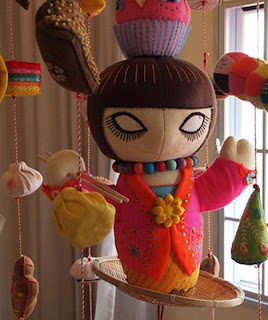
Of all the artworks I view, the first whimsical mobile hanged by the window, made from plush and felt, in the shapes of traditional Singapore food is the one that I like most!


For more photos of the artists' works, please view them via:
http://flickriver.com/photos/artituteart/sets/72157629302663309/
The mobile is created by Tye Sok Kuan who is a well-known freelance illustrator known for her alter-ego, Sophie Black.
In this hanging mobile, Sophie Black is also the centrepiece. I think most viewers would like all the yummy objects stringed around the smiling Nyonya, such as Ang Ku Kueh, Butterfly Kueh, Nine layers cake, Small Bao, Sue Mai, Kueh To To and many yummy and delicious local treats.
What I fall in love with is the bright and colourful hanging mobile theme with Paranaka ideas and the details stitches which is hard to match. To me it is like 3D painting using colourful treads as paint brush and felt as canvas!
I learn from this visit and meet some hosts of the homes. They were a nice mix of Singaporeans and expats and art is the one that transcends cultural borders.
Tiong Bahru is not a big estate and the distance between each homes which host the exhibitions are not very far apart. Nevertheless, all the apartment are without lift and walking up and down take time and energy.
After the 2 hours sweaty walking tour, our thigh muscles were tire. The expected workout for me allow me to make excuses for not having much physical exercises next week!
How do I feel about the tour at the end of the day? Well, like my tour mates, we feel intrusive, and on the other hand, was thankful to hosts who are so kind and so generous in giving us a change to peek, share and enjoy their way of living for a moment!
Maybe it is a learning journey for us to be humble about what we received and learn to share the joys by being kind and generous to others in the future!
Dexterine Ho Soo Miang
Monday, February 13, 2012
Advanced Certification in Library & Information Services (ACLIS)
By now, many of our LAS WSQ Level 2 course participants had completed the 5 modules required and received the Higher Certification in Library & Information Services (HCLIS). Most of them are interested to pursue the next level courses.
National Library Board Academy (NLBA) delivers WSQ Level 3 courses that help people in library services further their skills - and careers and the details can be found on NLBA web page at http://www.nlba.sg/library-professionals/view/aclis
The key areas are grouped into the following 8 units:
| Competency Code | Competency Unit (CU) | Credit Value |
|---|---|---|
| CI-LI-336C-0 | Administer Library Operations | 2 |
| CI-LI-341S-0 | Support General Reference and Information Enquiries | 2 |
| CI-LI-346S-0 | Support the Management of Promotion and Outreach Activities | 3 |
| CI-LI-340S-0 | Support the Management of Bibliographic Control Work | 3 |
| CI-LI-344S-0 | Support the Management of Circulation and Membership Services | 3 |
| CI-LI-343S-0 | Support the Management of Acquisitions and Serials Work | 3 |
| SV-PP-301G-0 | Coach Service Teams and Individuals | 3 |
| CI-LI-345S-0 | Support the Management of Collection Maintenance Work | 2 |
To understand the course structure and coverage of each unit, just visit
http://www.nlba.sg/library-professionals/view/aclis
Dexterine Ho Soo Miang
Sunday, February 12, 2012
Finding and creating yourself
Life isn't about finding yourself. Life is about creating yourself.
-- George Bernard Shaw
I think most of us are searching the path to find ourselves and the meaning of life in this earthy journey. Along the way, we created something different to call "self" and life fulfilment!
It is not possible and sometime a bit hard for most of us not to create something along the path we travel. We live a normal life, yet, it is normal not to repeat the way other did with their lives!
I find my creative incentive in my daily life, in library work, in learning and reading or in training new or old subjects!
It is the joys of having or experiencing something new from the world I lived, the people and events I experienced that make my days!
Sometime it is creation from my own explorations or with my hand works, sometime it is conversation with the like-minded and new works that give me great thrills in life and keep me going!
Personally, I think "creating" works for me! I find it easier to create something new than to follow something in existing practice.
It is "be" and "through the creation process", some self discovery is found and done.
I think to teach or train someone to do something is easy if we allow creation to happen naturally in the learning journey!
That is why I enjoy teaching and training as no session is the same. The learners, trainees and participants are creative souls that enrich the sessions.
Teaching is the way I share my experience and with the little light I hold, I can light up many candles that make the room illuminated.
When you are in the room with bright hearts that are shining and mirroring one another, learning is joyful and training is contentment!
Dexterine Ho Soo Miang
-- George Bernard Shaw
I think most of us are searching the path to find ourselves and the meaning of life in this earthy journey. Along the way, we created something different to call "self" and life fulfilment!
It is not possible and sometime a bit hard for most of us not to create something along the path we travel. We live a normal life, yet, it is normal not to repeat the way other did with their lives!
I find my creative incentive in my daily life, in library work, in learning and reading or in training new or old subjects!
It is the joys of having or experiencing something new from the world I lived, the people and events I experienced that make my days!
Sometime it is creation from my own explorations or with my hand works, sometime it is conversation with the like-minded and new works that give me great thrills in life and keep me going!
Personally, I think "creating" works for me! I find it easier to create something new than to follow something in existing practice.
It is "be" and "through the creation process", some self discovery is found and done.
I think to teach or train someone to do something is easy if we allow creation to happen naturally in the learning journey!
That is why I enjoy teaching and training as no session is the same. The learners, trainees and participants are creative souls that enrich the sessions.
Teaching is the way I share my experience and with the little light I hold, I can light up many candles that make the room illuminated.
When you are in the room with bright hearts that are shining and mirroring one another, learning is joyful and training is contentment!
Dexterine Ho Soo Miang
Friday, February 10, 2012
Publishing professional books: LexisNexis
The Academic Publishing talk – Publishing professional books: When your audience are busy practitioners, by Norainni Rahman, Director of Publishing, Lexis-Nexis, Southeast Asia was originally scheduled from:
12:00 PM to 02:00 PM
10 Feb 2012
Venue : LT22
Venue : http://maps.ntu.edu.sg/maps#q:LT22
It was jointly organised by NTU Libraries and LexisNexis. As the NTU Career Fair was on at the same time, the speaker was late, so do I as all nearby car parks are full and waiting in queue do not have any chance in getting a paid covered slot after 30 mins at the south spine car park!
I finally give up waiting and park my car at Heritage Centre and walk to LT 22!
12:00 PM to 02:00 PM
10 Feb 2012
Venue : LT22
Venue : http://maps.ntu.edu.sg/maps#q:LT22
It was jointly organised by NTU Libraries and LexisNexis. As the NTU Career Fair was on at the same time, the speaker was late, so do I as all nearby car parks are full and waiting in queue do not have any chance in getting a paid covered slot after 30 mins at the south spine car park!
I finally give up waiting and park my car at Heritage Centre and walk to LT 22!
If you were unable to attend the talk, you did not miss much as the slides can be accessed here!
The short session last less than 40 mins and it was an informal conversation with Q and A.
As I had travelled all the way from town and miss the other session at SMU, I was a bit disappointed at my own choice.
Sometime, you cannot judge the talk by the title! Being a Librarian, I should know judging a book by its cover is not the right way of book selection! Yet, I have to learn it by experience! I am a person without much wisdom, after all!
Never mind, it is a good lesson and I learn to exercise my choice better next time!
Dexterine Ho Soo Miang
Thursday, February 09, 2012
Have made some difference ...
I think the purpose of life is to be useful,
to be responsible,
to be honorable,
to be compassionate.
It is, after all, to matter:
to count,
to stand for something,
to have made some difference that you lived at all.
-- Leo C. Rosten (1908-1977) American Writer
to be responsible,
to be honorable,
to be compassionate.
It is, after all, to matter:
to count,
to stand for something,
to have made some difference that you lived at all.
-- Leo C. Rosten (1908-1977) American Writer
Monday, February 06, 2012
How to get published in international journals: Wiley-Blackwell
Just attended the inaugural Academic Publishing talk organized by NTU Library:
How to get published in international journals
by Dr. Carol Bacchus-Wermke, VP & Publishing Director from Wiley-Blackwell.
How to get published in international journals
by Dr. Carol Bacchus-Wermke, VP & Publishing Director from Wiley-Blackwell.
Many of my library counterparts were unable to attend the talk, here is the PPT Dr Caral Bacchus-Wermke used in her presentation today. If you are interested just click here.
Wiley-Blackwell has other resources for authors at http://authorservices.wiley.com/
To attend other Academic Publishing talks organized by NTU Library and academic publishers, just visit http://www3.ntu.edu.sg/lib/publishing/ and do the registration.
The nine Academic Publishing talks are opened to LAS members as well as the general public.
The nine Academic Publishing talks are opened to LAS members as well as the general public.
Dexterine Ho Soo Miang
Thursday, February 02, 2012
What it takes to be a 21st century librarian?
Is there more to the job than stamping due dates for a librarian? I recalled "Yan Chuin" told me in 1981 that some one did ask her why there is a need to go overseas and do a Post-graduate Diploma in Librarianship since the job of a librarian is that simple.
Well, I think it is hard to unlock that kind of thought as all the library users do not see the full range of works done by librarians at various levels.
What they see in their daily visits to the library is just the tip of the iceberg. They harvest the fruits of the labours by librarians and library staff like the way we get rice from supermarket.
When rice is purchased from the shelf, many kids and adults may not know the hard work of the peasants and workers in planting and milling rice.
Many library readers borrow books from the library do not really know how books make its way to the library shelf. When they remove the books from the shelf, they do not need to know how it was returned to the same place in the original order.
Why library always have some books that they like? Most readers are of different professions and at different age and continue to grow in their life journey or career path, how could the library facilitates their diverse and changing needs?
Now we have ebooks and Internet, hence, more and more people think that the world may not need a physical library and the service of librarians.
Emma Cragg and Katie Birkwood write "Beyond books: what it takes to be a 21st century librarian" and the article is published in guardian.co.uk,
Both of them try to clear the mental doubt and explain in details "From connecting with people to keeping up with the latest technologies, there is a whole lot more to the job than stamping due dates"
Full text of the article is available at
http://careers.guardian.co.uk/job-of-21st-century-librarianWell, I think it is hard to unlock that kind of thought as all the library users do not see the full range of works done by librarians at various levels.
What they see in their daily visits to the library is just the tip of the iceberg. They harvest the fruits of the labours by librarians and library staff like the way we get rice from supermarket.
When rice is purchased from the shelf, many kids and adults may not know the hard work of the peasants and workers in planting and milling rice.
Many library readers borrow books from the library do not really know how books make its way to the library shelf. When they remove the books from the shelf, they do not need to know how it was returned to the same place in the original order.
Why library always have some books that they like? Most readers are of different professions and at different age and continue to grow in their life journey or career path, how could the library facilitates their diverse and changing needs?
Now we have ebooks and Internet, hence, more and more people think that the world may not need a physical library and the service of librarians.
Emma Cragg and Katie Birkwood write "Beyond books: what it takes to be a 21st century librarian" and the article is published in guardian.co.uk,
Both of them try to clear the mental doubt and explain in details "From connecting with people to keeping up with the latest technologies, there is a whole lot more to the job than stamping due dates"
Full text of the article is available at
Here are some points I extracted to share with the readers here:
* ... many people's experience of librarians is of the frontline, customer service staff. Have you ever considered how the books get on to the shelves and ready for you to borrow? Behind the scenes there are teams of librarians working to make this happen.
* There are librarians who select the books for purchase... process the orders and ... create the bibliographic records that make it possible for you to find the book in the library catalogue and then on the shelves.
* Books are only one aspect... Librarianship is a people profession; a librarian's job is to connect people with the information they are seeking, whatever format that may take.
* ... library jobs have a central purpose: to help people access and use information, for education, for work, or for pleasure.
* ... customer service and communication skills are important. If anyone ever thought they'd become a librarian because they liked books or reading, they would be sorely disappointed if they did not also like people too.
* Libraries of all kinds are keen to demonstrate their value to as wide an audience as possible, and to open up access to culturally significant resources that they hold.
* In the digital age, when information is increasingly becoming available online, there is a propensity to say that libraries and librarians are redundant. This is not the case. Information available online is often of dubious origin and there is still a wealth of information behind paywalls that can only be accessed by those who have paid.
* ... helped many library users ... using search engines for their research ...
* ... being good communicators with people and active adopters and exploiters of technological developments, librarians need to have detailed specialist subject knowledge to pass on to library users.
* Librarians provide training to show people how to search for information and evaluate what they find.
* These information skills sessions ... include digital literacies ... stay safe online ... social media sites and online collaboration tools.
Emma acts as the liaison between the university library and the business school at the University of Warwick. Many of the resources used by business students come in digital form, as online journals, databases, or ebooks... She also provides training to help staff and students make the most of the resources available. Her technological skills and interests extend to the use of social media for education and professional development.
The library serves 1,600 local primary care trust (PCT) staff as well as health students, social care staff and the general public. Michael's daily work involves looking after the physical library space and helping readers with the systematic searches of health and medical literature necessary for research and good treatment practice ... and works on collaborative projects with NHS teams and public libraries to improve access to health and mental health resources for the general public.
Kate is cataloguing the papers of 20th-century scientist Sir Fred Hoyle (1915-2001)... focus of her work is organising and running events for the general public. These events open up the library and display. It helps to interpret its treasures for people of all educational levels and backgrounds. Kate also works with schools and other special interest groups to supplement and broaden curricula... her role is like teacher, curator, creative designer and tour guide.
http://careers.guardian.co.uk/job-of-21st-century-librarian
* There are librarians who select the books for purchase... process the orders and ... create the bibliographic records that make it possible for you to find the book in the library catalogue and then on the shelves.
* Books are only one aspect... Librarianship is a people profession; a librarian's job is to connect people with the information they are seeking, whatever format that may take.
* ... library jobs have a central purpose: to help people access and use information, for education, for work, or for pleasure.
* ... customer service and communication skills are important. If anyone ever thought they'd become a librarian because they liked books or reading, they would be sorely disappointed if they did not also like people too.
* Libraries of all kinds are keen to demonstrate their value to as wide an audience as possible, and to open up access to culturally significant resources that they hold.
* In the digital age, when information is increasingly becoming available online, there is a propensity to say that libraries and librarians are redundant. This is not the case. Information available online is often of dubious origin and there is still a wealth of information behind paywalls that can only be accessed by those who have paid.
* ... helped many library users ... using search engines for their research ...
* ... being good communicators with people and active adopters and exploiters of technological developments, librarians need to have detailed specialist subject knowledge to pass on to library users.
* Librarians provide training to show people how to search for information and evaluate what they find.
* These information skills sessions ... include digital literacies ... stay safe online ... social media sites and online collaboration tools.
* There is no standard route into librarianship: librarians have first degrees across the whole spectrum of subjects. To become a professionally qualified librarian you also need a masters qualification in librarianship or information science...
* An introduction to librarianship can be gained through a graduate trainee scheme. These are run by libraries in a variety of sectors... prior to the masters course...
* More information about the wide range of jobs undertaken by librarians can be found through the Library Day in the Life project...
* If you are interested in finding out about how to embark on a career in librarianship, Ned Potter has summarised the ten things you need to know if you want to work in libraries. Many librarians have also written about their route into the profession through the Library Routes Project.
Some Case studies cited in the article are:
Kate Smyth, project officer for children and young people, Oldham library and information service
Kate ... run Warhammer, Lego and Yu-Gi-Oh (toy and game) clubs in Oldham's libraries, and also with younger children as the organiser of sessions for young carers and library sleepovers for Scout groups. ... Kate's focus on the personal relationships central to library work continues with her role as administrator for the library's Twitter, Flickr and Facebook accounts, and she is also responsible for the library content on the Go Oldham website.Emma Cragg, academic support librarian, University of Warwick
Emma Cragg and Katie Birkwood are academic librarians and participants of the Library Day in the Life project
Please read the full text at
Subscribe to:
Posts (Atom)