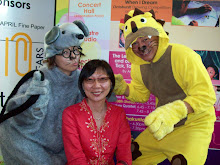
Here is the contribution from another course participant, Prabhu Singam:
=====
National library of Australia catalogue is one of the most useful free bibliographic utilities with more than 400 million books, images, historic newspapers, maps, music, archives records that can be of prodigious help to catalogers.
A simple title search for a resource would illicit an array of results broken down neatly according to the material type.
Comprehensive information about resources including summaries of books can be obtained from the records at trove.
The ubiquitous availability of music scores bibliographic information with the Dewey decimal classification number makes trove one of my personal favorite tool for cataloging as the resources I catalog usually involves a legion of music scores.
=====
Thanks to Prabhu for his insightful sharing on Bibliographic Utilities - Trove
21 - 22 Jan are assessment days for this module "Support Bibliographic Control", I hereby wishing Prabhu and all the candidates all the best for the coming assessment!
Dexterine Ho Soo Miang
Showing posts with label Bibliographic control teaching example. Show all posts
Showing posts with label Bibliographic control teaching example. Show all posts
Wednesday, January 21, 2015


Saturday, January 10, 2015
Z39.50
The LAS WSQ "Support Bibliographic Control" module, Jan 6-8 just ended, and I am glad that all the 15 trainees were active participants. We have great information sharing sessions in this three days of "Support Bibliographic Control" course.
With all the sharing of participants, the course not only enrich the knowledge of trainees, but also that of the trainers like me.
I just want to highlight the contribution of Ms Elaine Fong, Teacher Librarian on Z39.50. Here is her email sharing:
With all the sharing of participants, the course not only enrich the knowledge of trainees, but also that of the trainers like me.
I just want to highlight the contribution of Ms Elaine Fong, Teacher Librarian on Z39.50. Here is her email sharing:
=====
Here's my blurb for your blog.
We use Z39.50 as it is a reliable source of MARC records from the British Library for UK books.
Since we use Alliance Plus and Destiny from Follett , which are American, this is a good compliment for English language sources that are not from the US.
From our cataloging class, I also learned about Trove from Prabhu from SOTA which will be useful for Australian sources.
It is very reliable as the records come from the National Library of Australia.
With these three sources, we should have English language books covered comprehensively from around the world.
=====
Thanks to the sharing from Elaine on Z39.50 as a reliable source of MARC records from the British Library for UK books!
Prabhu (from SOTA Library) sharing on reliable sources of MARC records from Trove will be useful for Australian sources. Hope to receive more detail from him via email soon!
To all the participants, have a good break and rest well during the week end!
See you on 21 or 22 Jan 2015 for assessment!
See you on 21 or 22 Jan 2015 for assessment!
All the best!
Dexterine Ho Soo Miang
Wednesday, January 07, 2015
M3 Bib Control: Activity
M3 Bib Control: Activity 11
7 Jan 2015, LG page 105
=====
Learning Activity 11:
Local applications and practices in cataloguing standards
=====
For example:
Library system(s): Sirsi Dynix, CARL, Aleph, … etc.
Bibliographic utilities used: OCLC, SILAS, others…., etc.
Tasks done in Cataloguing:
1. Assign Accession Nos., Barcode, etc. to individual items for Inventory Control
2. Search for records in bibliographic utilities (SILAS or OCLC)
3. Download or import records especially near match for DVDs. Reference materials, audio materials, etc.
4. Capture exact records
5. Edit records – MARC tags and fixed fields (like material types)
6. Assign Location codes for lending, reference, media, etc.
7 Jan 2015, LG page 105
=====
Learning Activity 11:
Local applications and practices in cataloguing standards
=====
For example:
Library system(s): Sirsi Dynix, CARL, Aleph, … etc.
Bibliographic utilities used: OCLC, SILAS, others…., etc.
Tasks done in Cataloguing:
1. Assign Accession Nos., Barcode, etc. to individual items for Inventory Control
2. Search for records in bibliographic utilities (SILAS or OCLC)
3. Download or import records especially near match for DVDs. Reference materials, audio materials, etc.
4. Capture exact records
5. Edit records – MARC tags and fixed fields (like material types)
6. Assign Location codes for lending, reference, media, etc.
Tuesday, January 06, 2015
Card Catalogue
I used card catalogue in 1980's when I started my librarianship journey, at Cataloguing Dept, Institute of Education Library in Aug 1982.
My first task was checking the filing of card catalogue. Title/Author entries were interfilded, subject heading is on its own. Call number card and shelf list were the two that I used to confuse myself.
Checking of filing manually was time consuming and taxing to the eyes. I still remembered that I had a hard time looking at the A to Z filing and trying to following the filing rules of Word-by-Word (not letter-by-letter).
Standing at the card catalogue for two hours in one run, doing correction and explaining to support staff on how filing rules should be applied was not an easy task for a new cataloguer like me.
One of the day in the first month, I finished work at 5 pm and was exhausted, after heading home and have dinner, I rested on bed at 7pm, without shower.
I woke up at 7 am the next morning and realised that I slept for 12 hours. I was late for work and have to rush for public transport and managed to report to IE library at 8.30am. I did not have breakfast that day and my mind was spinning before morning tea break.
=====
The Author/Title, Subject, Call Number and Shelf List card catalogue in IE Library then were made in metal. They were all in gray colour.
There were some wooden card catalogue used for specially collection, like Thesis and IE publications etc...
Nowaday, it is hard to find any library with the wooden catalogue cabinets in Singapore.
My first task was checking the filing of card catalogue. Title/Author entries were interfilded, subject heading is on its own. Call number card and shelf list were the two that I used to confuse myself.
Checking of filing manually was time consuming and taxing to the eyes. I still remembered that I had a hard time looking at the A to Z filing and trying to following the filing rules of Word-by-Word (not letter-by-letter).
Standing at the card catalogue for two hours in one run, doing correction and explaining to support staff on how filing rules should be applied was not an easy task for a new cataloguer like me.
One of the day in the first month, I finished work at 5 pm and was exhausted, after heading home and have dinner, I rested on bed at 7pm, without shower.
I woke up at 7 am the next morning and realised that I slept for 12 hours. I was late for work and have to rush for public transport and managed to report to IE library at 8.30am. I did not have breakfast that day and my mind was spinning before morning tea break.
=====
The Author/Title, Subject, Call Number and Shelf List card catalogue in IE Library then were made in metal. They were all in gray colour.
There were some wooden card catalogue used for specially collection, like Thesis and IE publications etc...
Nowaday, it is hard to find any library with the wooden catalogue cabinets in Singapore.
If your library do have a sample of card catalogue and the catalogue cabinets, do keep it and it will be your institution's heritage collection.
If you have photograph of the old catalogue cabinet, and would like to let me share through this blog, just email me:
dexterine@yahoo.com
or
smho@e.ntu.edu.sg
=====
Here is what I found in Wikepidia:
=====
Library catalog
From Wikipedia, the free encyclopedia


=====
Source of information:
http://en.wikipedia.org/wiki/Library_catalog
Originally posted on 5 April 2012, revised and updated on 6 Jan 2015.
Dexterine Ho Soo Miang
Subscribe to:
Posts (Atom)