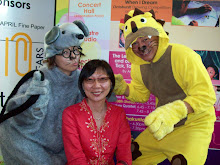
Today, I attended the Seminar On “Understanding Digital Preservation in the Context of Digital Library” organised by ExLibris Singapore:
Date: Monday, 31st Oct 2011
Time: 1400hr – 1700hr
Venue: Library Instructional Commons Block N2 Level B3A-01 Nanyang Technological University50 Nanyang Avenue, Singapore 639798
"With the transition from traditional paper to a digital library, many institutions are facing new challenges. One of the emerging challenges is in the field of digital preservation and its role as part of the digital library."
"Ex Libris Rosetta digital preservation solution provides a sustainable digital preservation model which enables institutions to collect, manage, preserve, and provide access to institutional documents, research output in digital formats, digital images, websites, and other digitally born and digitized materials."
Listening to Mr. John M. Meador, Jr, Dean of Libraries on his digital preservation experience in Binghamton University, was most inspiring to me.
He reminded us that "Digital Preservation Project" have to be conceived with the needs of interest groups in mind.
With interests from the academic groups who see the needs to preserve the objects, pictures or photographs etc, funding will follow.
Start with manageable and low hanging fruits first and move on to the higher goal.
It is not a "Zero or All" game. You can do comprehensive digital preservation steps by steps, not all at once!
Agenda:
1330 – 1400 NTU Library Tour (Business Library) & Registration
1400 – 1405 Welcome Speech: Mr. Choy Fatt Cheong, University Librarian, Nanyang Technological University Mr. Ziv BenZvi, Vice President, Ex Libris Asia Pacific
1405 – 1450 Overview of the world of digital preservation: Mr. Nir Sherwinter, Rosetta Business Analysis & Implementation Manager
1450 – 1535 Building a Digital Library for Binghamton University: Mr. John M. Meador, Jr, Dean of Libraries, Binghamton University
1535 – 1605 Tea break
1605 – 1650 Rosetta Overview & Live Demonstration: Mr. Nir Sherwinter, Rosetta Business Analysis & Implementation Manager
1650 – 1700 Q&A
Source of information:
http://www.exlibrisgroup.com/category/SingaporeRosetta
Monday, October 31, 2011


Monday, October 10, 2011
A joyful experience: moving around shelf
Just received some photos via email from one of the trainee and here I share with you two of the photos we took on the first day of SUPPORT COLLECTION MAINTENANCE (LAS WSQ Level 2 course: Module 4) held on 6 Sept 2011, Tuesday at National Library Academy Agatha Room.


The third run of the WSQ/LAS Level 2 training for Support Bibliographic Control work is on 8 – 10 November 2011. This 3 day course will be held at CR605, NTU@OneNorth.
The registration for November course "Support Bibliographic Control" is fully subscribed today!
If you are attending the course next month, see you at NTU@OneNorth then!
Dexterine Ho
Shelf reading: after lunch walking and standing exercise


All of us enjoy to be a "movable book" for once, and we are in the "right order" after the fun-filling shelf reading exercise!
For more information on the module, please refer to Library Assiciation of Singapore (LAS) Webpage athttp://www.las.org.sg/wp/training-development/for-support-staff/
The course fees are listed at http://www.las.org.sg/2011ScheduleWithCosts.xls
The course fees are listed at http://www.las.org.sg/2011ScheduleWithCosts.xls
LAS is the Approved Training Organisation (ATO) by WDA and offers the following five WSQ Level 2 Courses:
The registration for November course "Support Bibliographic Control" is fully subscribed today!
If you are attending the course next month, see you at NTU@OneNorth then!
Dexterine Ho
Sunday, October 09, 2011
Hertitage trail of Bukit Brown Cemetry
"But once you're gone, you belong to the world."
----Steve Jobs
I understand this quotation better today when I follow Mr Raymond Goh for a heritage trail of Bukit Brown Cemetery this morning.
With the inscriptions on the tomb stone, many personal information is revealed to the world and personal information is being channelled into public domain. Learning the intricate relationship among tombs in Bukit Brown Cemetery is an "eye and mind-opening" experience!
The trail started at 9am and I left around 12 noon. Many thanks to Raymond Goh, Charles Goh, Rosalind M Tan, Charlotte Chu and many other volunteers for making the event possible!
From the article "S’pore’s oldest grave?" at http://www.preshigh.edu.sg/teachers/laick/Singapore/Historical%20Sites/S'pore's%20oldest%20grave.aspx , I understand that Mr Raymond Goh is a pharmacist by day and use his free time researching tombs and cemeteries. The interest began in 2006 after he felt the importance of "preserving the past". He has since found many graves ofSingapore
This evening, I learned from the News on TV at 10pm that My friend Ms Rosalind Tan, 陈如琳, was able to re-locate the tombs of her grand parents, Mr and Mrs Tan Yong Thian, with the help of Raymond.
According to Rosalind, her grandfather Mr Tan Yong Thian (also known as Tan Ah Tian) born in 1855, came to Singapore in 1882 at the age of 27 from Chaoyang, in Swatow, China.
From http://wildsingaporenews.blogspot.com/2011/11/holistic-strategy-for-bukit-brown.html, I learn that "He started life in Singapore as a building contractor and later invested in various plantations. He was the first Chinese to distil patchouli oil successfully and his company, Chua Seng Heng, became the largest producer of essential oils in the Straits Settlements."
Viewing the [Obituaries] in The Straits Times, 4 March 1926, Page 8, I learned that Mrs. Tan Yong Thian nee Ng Hean Neo, passed away at age 59 on 1st March 1926. http://newspapers.nl.sg/Digitised/Issue/straitstimes19260304.aspx
Follow Raymond for the morning trail to explore and re-discover the pioneers in Singapore is a fulfuling experience for me. We have the chance of unveiling some interesting links between famous families in Singapore and understand the tombs' "networking pattern". Listening to the anecdotes and insightful decipher of the tombs and the plaques give us more indepth understanding of the hidden meaning embedded in the inscriptions and sculptures.
I recited and sing the poem "Qing Ming" by Du Mu, Tang Dynasty Poet, at the Tomb of Rosalind's Grand Parents in Teochew as a symbolic tribute to her ancestors. (晚唐著名诗人杜牧有一首脍炙人口的绝句《清明》,诗云:“清明时节雨纷纷,路上行人欲断魂。借问酒家何处有,牧童遥指杏花村。”
My translated version:
Drizzling rain always falls during Qing Ming days.
It's like the mourners' heart tearing sadly on their ways.
Where can a winehouse be found to diverse one's deep sorrow?
A little cowherd pointed to the Almond Flower (Xing Hua) Village, a distance away!
(Chinese words edited and English translation added on 15 Jan 2012 in response to Mr Ang Hock Chuan's posting the video on Facebook at http://www.facebook.com/photo.php?v=10150395630547491&mid=57 )
Being Teochew, Rosalind made a general request for a Teochew Tune/Song before we start the trail, and I think it is meaningful for me to do it for the deceased and share the sentiments with friends who make their way there.
==========
For background information, I found the following infopedia article very helpful:
Bukit Brown Municipal Cemetery
1973: "Previously a 211-acre plot of land that belonged to the Hokkien Ong clan, the Municipality had acquired a section of it in 1918-1919 to serve the burial needs of the wider Chinese community. It was opened for more than half a century until its closure in 1973."
Early beginnings of Bukit Brown
* George Henry Brown:
"Bukit Brown was named after George Henry Brown, a shipowner, trader and broker who arrived in Singapore in the 1840s. He opened a company named Brown, Knight & Co., at Malacca Street in 1865, and was also listed as a petit juror in the Singapore almanack and directory (1870). "
* Bukit Brown:
"Brown's place of residence was located at Mount Pleasant Road/Drive, a road close to the present Bukit Brown site. Although the hill on which Brown's residence stood was named after him, the road leading to Bukit Brown did not exist until much later."
* Bukit Brown Road
"When an access road to Bukit Brown was constructed, the road was named Bukit Brown Road in 1923. This road has since been expunged."
Seh Ong (Hokkien) Cemetery
1872: Ong clan "self-sufficient village"
"Prior to the opening of the municipal cemetery, the area was owned by three wealthy Hokkien entrepreneurs, Ong Kew Ho, Ong Ewe Hai and Ong Chong Chew, who came from the same village of Bai Qiao in Xiamen, China. In 1872, the trio bought a 211 acre site at Bukit Timah Road, also known as Bukit Brown (next to the Teck Rubber Estate at the fourth milestone), with the intention to set up a self-sufficient village for poorer members of the Ong clan. The land was to serve the community's residential, agricultural and burial needs."
Tai Yuan Shan 太原山, Xing Wang Shan 姓王山 and Kopi Sua (咖啡山Coffee hill)
"However, the land eventually came to be used solely as a burial ground. The reason for this change is unclear. The hill on which the Seh Ong Cemetery stood was also known to the Chinese as Tai Yuan Shan , Xing Wang Shan and Kopi Sua (coffee hill). The latter probably derived its name from the coffee plantations at Mount Pleasant."
Opening of the Bukit Brown Cemetery
1918-1919
"To meet the pressing need for more public Chinese burial grounds, the Municipal government acquired a section of the Seh Ong Cemetery in 1918-1919 to serve the needs of the wider Chinese community."
1922
"The cemetery officially opened on 1 January 1922. Initially, various aspects of the cemetery's management were handled by the Municipal Commissioners."
1923
"However in 1923, they decided that internal arrangements relating to the cemetery should be left to the Chinese Commissioners to make their recommendations to the Board."
A cemetery for the wider Chinese community
25 August 1922 Amendment (Section 245, no. 9)
"Since the Bukit Brown Cemetery was set up to serve the burial needs of the wider Chinese community, rich and poor, all were to be given equal access to burial plots. To this end, an amendment (Section 245, no. 9) was passed at a special meeting of the Commissioners held on 25 August 1922."
January 1923 and April 1923
"The amendment stated that no special favours would be given to any members of the community. Incidences where one person was allocated to two burial plots were no longer permitted. The by-law came into effect on 21 September 1923. Between the date when the amendment was passed and its effective date, two cases of double occupancy took place in January 1923 and April 1923 respectively."
1929
"Bukit Brown was initially unpopular with the Chinese because of its small plot sizes. However, it slowly gained acceptance after improvements were made to the layout. It was reported that by 1929, 40% of all officially registered Chinese burials within the municipality took place there."
Up-keeping problems
"The Commissioners also sought to improve the conditions of the cemetery. In the beginning, two rest houses were allocated for funeral visitors. A regular water supply was provided through the construction of water pipes and wells, and gardeners were hired to maintain the site. Despite this, complaints about the unkempt appearance of the cemetery occasionally appeared in the newspapers."
Other problems at the cemetery
"Aside from municipal issues, murders, robberies and faction fights were also known occurrences."
1927
"One of the earliest murders at the cemetery took place in 1927. A fight between two groups led to the fatal stabbing of two Chinese men."
1933
"On 24 July 1933, The Straits Times reported on a fight which broke out in the middle of a full funeral procession of a famous towkay, attended by 1,000 people at the cemetery. The clash was sparked by two secret societies in conflict. As a result of the skirmish, six people were taken to the hospital."
1980
"In 1980, a robbery took the life of the cemetery's caretaker and part-time gardener. The caretaker was found dead with 15 years of his life savings missing."
* Swapping of burial plots
"In addition to murders, fights and robberies, there was also the peculiar problem of the illegal swapping of burial plots. There was considerable black-marketeering of Chinese burial plots. This is evident in the advertisements of that period. Notices inviting transfers of burial plots at Bukit Brown Cemetery were advertised in the newspapers. Such transactions were against the Municipal's by-laws and were not recognised by the Commissioners."
"Despite the Commissioners' assurance that there was no lack of burial space, such practices continued. It is not clear from the reports what drove the demand for blackmarket burial plots or the illegal swapping of burial plots. It could be due to lack of space as some felt that the sizes of the burial plots were too small or the Chinese preference for burying family members close by, hence the need to swap plots."
Prominent personalities buried at Bukit Brown
"Many well-known and prominent Singaporeans are interred at Bukit Brown Municipal Cemetery. They include Mrs Eu Kong, mother of Eu Tong Sen; Loh Kye Wee, director of Malaya Broadcasting Co.; Tan Lark Sye, philanthropist and rubber magnate; Ong Sam Leong, renowned entrepreneur; Ong Boon Tat, proprietor of New World Park; Mrs Lim Nee Soon, Lim Chong Pang, which Chong Pang village was named after; and Chew Boon Lay of Boon Lay estate. Some of these graves have been around since the establishment of the Seh Ong Cemetery."
"One of the more memorable funeral processions that took place at the cemetery was the singing of Malay pantun-pantun (poems) at the funeral of Koh Hoon Teck, one of the "old guards" of the Peranakan community in Singapore. It had been one of his wishes that Malay poetry be sung at his funeral. As he was a pantun expert and a founding member of the Dondang Sayang Association, his family members, close friends and members of the association arranged for a "pantun party" to be held at the cemetery. This was done in an elaborate Ming fashion as his other wish was to be interred in robes of the Ming period."
Features of tombs
"The tomb of Ong Sam Leong and his wife in Bukit Brown is said to be the largest tomb in Singapore. Built in 1918 before plot sizes were fixed, the area is reported to be as large as 10 small Housing and Development Board (HDB) flats. Unlike most tombs that have either a small groove or ditch, its front perimeter is 15m long. Also, while most graves are adorned with decorations from traditional Chinese mythology such as lion statues, the Ong tomb is one of several tombs that have statues of Sikh watchmen which stand guard over the grave instead."
1923: Bukit Brown Road & Kheam Hock Road
"On 1 June 1923, the Committee of Municipal Commissioners decided to name the first portion of the road from Bukit Timah Road to the golf club Bukit Brown Road. It was also decided that the the road from Bukit Brown Road leading to the cemetery should be called Kheam Hock Road, in memory of Municipal Commissioner Tan Kheam Hock, who had actively lobbied for the establishment of the cemetery. Tan had passed away in April 1922. In 1925, one of the Municipal Commissioners, See Tiong Wah, noted the growing popularity of the road leading to the cemetery and suggested a widening of Kheam Hock Road to 60 feet and the wooden bridge leading to it. This suggestion was, however, rejected."
1965: Graveyard divided into two
"Though the Bukit Brown Cemetery faces the threat of redevelopment in land-scarce Singapore, no formal plans have yet been made known. The Land Transport Authority has, however, announced the construction of a Bukit Brown MRT station at Jalan Mashor, near the cemetery. It will be one of the 13 new MRT stations along the Circle Line between the Thomson Road area and Harbour Front. Although the Circle Line is due for completion in 2010, the Bukit Brown MRT station will remain unfinished until the area becomes more developed. In the meantime, the proposed MRT station will be constructed as a "shell station" - a stop with basic structures such as ventilation shafts for the MRT tunnel, and underground concrete boxes to house the future station."
"In 1965, the Public Works Department (PWD) issued a statement that the graves on state land in Bukit Brown Cemetery, about 237 tombs, were to be exhumed to make way for the realignment of Lornie Road, off Adam Road. On 18 January 1965, these tombs were exhumed for interment at the Choa Chu Kang Cemetery. A notice by the PWD, published in The Straits Times on 25 March 1965, provided the names of the deceased, the number of the corresponding grave plots, previous addresses and burial dates."
Closure of the cemetery
----Steve Jobs
I understand this quotation better today when I follow Mr Raymond Goh for a heritage trail of Bukit Brown Cemetery this morning.
With the inscriptions on the tomb stone, many personal information is revealed to the world and personal information is being channelled into public domain. Learning the intricate relationship among tombs in Bukit Brown Cemetery is an "eye and mind-opening" experience!
The trail started at 9am and I left around 12 noon. Many thanks to Raymond Goh, Charles Goh, Rosalind M Tan, Charlotte Chu and many other volunteers for making the event possible!
From the article "S’pore’s oldest grave?" at http://www.preshigh.edu.sg/teachers/laick/Singapore/Historical%20Sites/S'pore's%20oldest%20grave.aspx , I understand that Mr Raymond Goh is a pharmacist by day and use his free time researching tombs and cemeteries. The interest began in 2006 after he felt the importance of "preserving the past". He has since found many graves of
This evening, I learned from the News on TV at 10pm that My friend Ms Rosalind Tan, 陈如琳, was able to re-locate the tombs of her grand parents, Mr and Mrs Tan Yong Thian, with the help of Raymond.
According to Rosalind, her grandfather Mr Tan Yong Thian (also known as Tan Ah Tian) born in 1855, came to Singapore in 1882 at the age of 27 from Chaoyang, in Swatow, China.
From http://wildsingaporenews.blogspot.com/2011/11/holistic-strategy-for-bukit-brown.html, I learn that "He started life in Singapore as a building contractor and later invested in various plantations. He was the first Chinese to distil patchouli oil successfully and his company, Chua Seng Heng, became the largest producer of essential oils in the Straits Settlements."
Viewing the [Obituaries] in The Straits Times, 4 March 1926, Page 8, I learned that Mrs. Tan Yong Thian nee Ng Hean Neo, passed away at age 59 on 1st March 1926. http://newspapers.nl.sg/Digitised/Issue/straitstimes19260304.aspx
Follow Raymond for the morning trail to explore and re-discover the pioneers in Singapore is a fulfuling experience for me. We have the chance of unveiling some interesting links between famous families in Singapore and understand the tombs' "networking pattern". Listening to the anecdotes and insightful decipher of the tombs and the plaques give us more indepth understanding of the hidden meaning embedded in the inscriptions and sculptures.
I recited and sing the poem "Qing Ming" by Du Mu, Tang Dynasty Poet, at the Tomb of Rosalind's Grand Parents in Teochew as a symbolic tribute to her ancestors. (晚唐著名诗人杜牧有一首脍炙人口的绝句《清明》,诗云:“清明时节雨纷纷,路上行人欲断魂。借问酒家何处有,牧童遥指杏花村。”
My translated version:
Drizzling rain always falls during Qing Ming days.
It's like the mourners' heart tearing sadly on their ways.
Where can a winehouse be found to diverse one's deep sorrow?
A little cowherd pointed to the Almond Flower (Xing Hua) Village, a distance away!
(Chinese words edited and English translation added on 15 Jan 2012 in response to Mr Ang Hock Chuan's posting the video on Facebook at http://www.facebook.com/photo.php?v=10150395630547491&mid=57 )
Being Teochew, Rosalind made a general request for a Teochew Tune/Song before we start the trail, and I think it is meaningful for me to do it for the deceased and share the sentiments with friends who make their way there.
==========
For background information, I found the following infopedia article very helpful:
Bukit Brown Municipal Cemetery
By Kartini Saparudin written on 13-Jul-2009
National Library Board Singapore
http://infopedia.nl.sg/articles/SIP_1358_2009-07-13.html
Here are useful pointers and information from the full text of the article (Some headings and dates are highlighted/added for quick reference, it is like reading the full text with some annotations, esp the name of places in Chinese translation):
Bukit Brown Municipal Cemetery
1922:
"The Bukit Brown Municipal Cemetery, located between Lornie Road and Mount Pleasant Road, was officially opened on 1 January 1922."
National Library Board Singapore
http://infopedia.nl.sg/articles/SIP_1358_2009-07-13.html
Here are useful pointers and information from the full text of the article (Some headings and dates are highlighted/added for quick reference, it is like reading the full text with some annotations, esp the name of places in Chinese translation):
Bukit Brown Municipal Cemetery
1922:
"The Bukit Brown Municipal Cemetery, located between Lornie Road and Mount Pleasant Road, was officially opened on 1 January 1922."
1973: "Previously a 211-acre plot of land that belonged to the Hokkien Ong clan, the Municipality had acquired a section of it in 1918-1919 to serve the burial needs of the wider Chinese community. It was opened for more than half a century until its closure in 1973."
Early beginnings of Bukit Brown
* George Henry Brown:
"Bukit Brown was named after George Henry Brown, a shipowner, trader and broker who arrived in Singapore in the 1840s. He opened a company named Brown, Knight & Co., at Malacca Street in 1865, and was also listed as a petit juror in the Singapore almanack and directory (1870). "
* Bukit Brown:
"Brown's place of residence was located at Mount Pleasant Road/Drive, a road close to the present Bukit Brown site. Although the hill on which Brown's residence stood was named after him, the road leading to Bukit Brown did not exist until much later."
* Bukit Brown Road
"When an access road to Bukit Brown was constructed, the road was named Bukit Brown Road in 1923. This road has since been expunged."
Seh Ong (Hokkien) Cemetery
1872: Ong clan "self-sufficient village"
"Prior to the opening of the municipal cemetery, the area was owned by three wealthy Hokkien entrepreneurs, Ong Kew Ho, Ong Ewe Hai and Ong Chong Chew, who came from the same village of Bai Qiao in Xiamen, China. In 1872, the trio bought a 211 acre site at Bukit Timah Road, also known as Bukit Brown (next to the Teck Rubber Estate at the fourth milestone), with the intention to set up a self-sufficient village for poorer members of the Ong clan. The land was to serve the community's residential, agricultural and burial needs."
Tai Yuan Shan 太原山, Xing Wang Shan 姓王山 and Kopi Sua (咖啡山Coffee hill)
"However, the land eventually came to be used solely as a burial ground. The reason for this change is unclear. The hill on which the Seh Ong Cemetery stood was also known to the Chinese as Tai Yuan Shan , Xing Wang Shan and Kopi Sua (coffee hill). The latter probably derived its name from the coffee plantations at Mount Pleasant."
Opening of the Bukit Brown Cemetery
1918-1919
"To meet the pressing need for more public Chinese burial grounds, the Municipal government acquired a section of the Seh Ong Cemetery in 1918-1919 to serve the needs of the wider Chinese community."
1922
"The cemetery officially opened on 1 January 1922. Initially, various aspects of the cemetery's management were handled by the Municipal Commissioners."
1923
"However in 1923, they decided that internal arrangements relating to the cemetery should be left to the Chinese Commissioners to make their recommendations to the Board."
A cemetery for the wider Chinese community
25 August 1922 Amendment (Section 245, no. 9)
"Since the Bukit Brown Cemetery was set up to serve the burial needs of the wider Chinese community, rich and poor, all were to be given equal access to burial plots. To this end, an amendment (Section 245, no. 9) was passed at a special meeting of the Commissioners held on 25 August 1922."
January 1923 and April 1923
"The amendment stated that no special favours would be given to any members of the community. Incidences where one person was allocated to two burial plots were no longer permitted. The by-law came into effect on 21 September 1923. Between the date when the amendment was passed and its effective date, two cases of double occupancy took place in January 1923 and April 1923 respectively."
1929
"Bukit Brown was initially unpopular with the Chinese because of its small plot sizes. However, it slowly gained acceptance after improvements were made to the layout. It was reported that by 1929, 40% of all officially registered Chinese burials within the municipality took place there."
Up-keeping problems
"The Commissioners also sought to improve the conditions of the cemetery. In the beginning, two rest houses were allocated for funeral visitors. A regular water supply was provided through the construction of water pipes and wells, and gardeners were hired to maintain the site. Despite this, complaints about the unkempt appearance of the cemetery occasionally appeared in the newspapers."
Other problems at the cemetery
"Aside from municipal issues, murders, robberies and faction fights were also known occurrences."
1927
"One of the earliest murders at the cemetery took place in 1927. A fight between two groups led to the fatal stabbing of two Chinese men."
1933
"On 24 July 1933, The Straits Times reported on a fight which broke out in the middle of a full funeral procession of a famous towkay, attended by 1,000 people at the cemetery. The clash was sparked by two secret societies in conflict. As a result of the skirmish, six people were taken to the hospital."
1980
"In 1980, a robbery took the life of the cemetery's caretaker and part-time gardener. The caretaker was found dead with 15 years of his life savings missing."
* Swapping of burial plots
"In addition to murders, fights and robberies, there was also the peculiar problem of the illegal swapping of burial plots. There was considerable black-marketeering of Chinese burial plots. This is evident in the advertisements of that period. Notices inviting transfers of burial plots at Bukit Brown Cemetery were advertised in the newspapers. Such transactions were against the Municipal's by-laws and were not recognised by the Commissioners."
"Despite the Commissioners' assurance that there was no lack of burial space, such practices continued. It is not clear from the reports what drove the demand for blackmarket burial plots or the illegal swapping of burial plots. It could be due to lack of space as some felt that the sizes of the burial plots were too small or the Chinese preference for burying family members close by, hence the need to swap plots."
Prominent personalities buried at Bukit Brown
"Many well-known and prominent Singaporeans are interred at Bukit Brown Municipal Cemetery. They include Mrs Eu Kong, mother of Eu Tong Sen; Loh Kye Wee, director of Malaya Broadcasting Co.; Tan Lark Sye, philanthropist and rubber magnate; Ong Sam Leong, renowned entrepreneur; Ong Boon Tat, proprietor of New World Park; Mrs Lim Nee Soon, Lim Chong Pang, which Chong Pang village was named after; and Chew Boon Lay of Boon Lay estate. Some of these graves have been around since the establishment of the Seh Ong Cemetery."
"One of the more memorable funeral processions that took place at the cemetery was the singing of Malay pantun-pantun (poems) at the funeral of Koh Hoon Teck, one of the "old guards" of the Peranakan community in Singapore. It had been one of his wishes that Malay poetry be sung at his funeral. As he was a pantun expert and a founding member of the Dondang Sayang Association, his family members, close friends and members of the association arranged for a "pantun party" to be held at the cemetery. This was done in an elaborate Ming fashion as his other wish was to be interred in robes of the Ming period."
Features of tombs
"The tomb of Ong Sam Leong and his wife in Bukit Brown is said to be the largest tomb in Singapore. Built in 1918 before plot sizes were fixed, the area is reported to be as large as 10 small Housing and Development Board (HDB) flats. Unlike most tombs that have either a small groove or ditch, its front perimeter is 15m long. Also, while most graves are adorned with decorations from traditional Chinese mythology such as lion statues, the Ong tomb is one of several tombs that have statues of Sikh watchmen which stand guard over the grave instead."
Oldest grave?
1833
"On 21 March 2010, a newspaper report claimed that the oldest grave in Bukit Brown dated to as early as 1833, not 1844 as previously claimed. The headstone belongs to a man called Fang Shan, who died in 1833. Fang Shan's grave is looked after by the Fang Shee Association, a local clan association for those with the surname Fang. The more important part of this discovery was that it was also believed to be the oldest known grave to date."
"According to the National Archives of Singapore, which keeps burial records, the oldest grave here dates back to 2 April 1865. This grave was at the Bukit Timah Road Old Cemetery, also known as the Kampong Java Cemetery. According to the National Environment Agency, it was exhumed together with the other 8,461 graves in the cemetery, and the remains reburied at Choa Chu Kang Christian Cemetery in 1970.In 2006, The Straits Times reported that a tomb dating back to 1842 had been found near the current National University of Singapore law school campus."
Roads in and around Bukit Brown
1833
"On 21 March 2010, a newspaper report claimed that the oldest grave in Bukit Brown dated to as early as 1833, not 1844 as previously claimed. The headstone belongs to a man called Fang Shan, who died in 1833. Fang Shan's grave is looked after by the Fang Shee Association, a local clan association for those with the surname Fang. The more important part of this discovery was that it was also believed to be the oldest known grave to date."
"According to the National Archives of Singapore, which keeps burial records, the oldest grave here dates back to 2 April 1865. This grave was at the Bukit Timah Road Old Cemetery, also known as the Kampong Java Cemetery. According to the National Environment Agency, it was exhumed together with the other 8,461 graves in the cemetery, and the remains reburied at Choa Chu Kang Christian Cemetery in 1970.In 2006, The Straits Times reported that a tomb dating back to 1842 had been found near the current National University of Singapore law school campus."
Roads in and around Bukit Brown
1923: Bukit Brown Road & Kheam Hock Road
"On 1 June 1923, the Committee of Municipal Commissioners decided to name the first portion of the road from Bukit Timah Road to the golf club Bukit Brown Road. It was also decided that the the road from Bukit Brown Road leading to the cemetery should be called Kheam Hock Road, in memory of Municipal Commissioner Tan Kheam Hock, who had actively lobbied for the establishment of the cemetery. Tan had passed away in April 1922. In 1925, one of the Municipal Commissioners, See Tiong Wah, noted the growing popularity of the road leading to the cemetery and suggested a widening of Kheam Hock Road to 60 feet and the wooden bridge leading to it. This suggestion was, however, rejected."
1965: Graveyard divided into two
"Though the Bukit Brown Cemetery faces the threat of redevelopment in land-scarce Singapore, no formal plans have yet been made known. The Land Transport Authority has, however, announced the construction of a Bukit Brown MRT station at Jalan Mashor, near the cemetery. It will be one of the 13 new MRT stations along the Circle Line between the Thomson Road area and Harbour Front. Although the Circle Line is due for completion in 2010, the Bukit Brown MRT station will remain unfinished until the area becomes more developed. In the meantime, the proposed MRT station will be constructed as a "shell station" - a stop with basic structures such as ventilation shafts for the MRT tunnel, and underground concrete boxes to house the future station."
"The portion of the state land of Bukit Brown was exhumed to make way for the alignment of Lornie Road, off Adam Road, in 1965. Later, the graveyard was also divided into two sections due to the construction of the Pan Island Expressway in the 1970s. The other part of the cemetery is called Mount Pleasant Cemetery."
Exhumation in Bukit Brown Cemetery
1965: 237 tombs
"In 1965, the Public Works Department (PWD) issued a statement that the graves on state land in Bukit Brown Cemetery, about 237 tombs, were to be exhumed to make way for the realignment of Lornie Road, off Adam Road. On 18 January 1965, these tombs were exhumed for interment at the Choa Chu Kang Cemetery. A notice by the PWD, published in The Straits Times on 25 March 1965, provided the names of the deceased, the number of the corresponding grave plots, previous addresses and burial dates."
Closure of the cemetery
1973
"The Bukit Brown Cemetery closed for burial in 1973. There were about 100,000 tombs at that time."
Future developments
"Though the Bukit Brown Cemetery faces the threat of redevelopment in land-scarce Singapore, no formal plans have yet been made known. The Land Transport Authority has, however, announced the construction of a Bukit Brown MRT station at Jalan Mashor, near the cemetery. It will be one of the 13 new MRT stations along the Circle Line between the Thomson Road area and Harbour Front. Although the Circle Line is due for completion in 2010, the Bukit Brown MRT station will remain unfinished until the area becomes more developed. In the meantime, the proposed MRT station will be constructed as a "shell station" - a stop with basic structures such as ventilation shafts for the MRT tunnel, and underground concrete boxes to house the future station."
=====
Source of information:Bukit Brown Municipal Cemetery
By Kartini Saparudin written on 13-Jul-2009
National Library Board Singapore
http://infopedia.nl.sg/articles/SIP_1358_2009-07-13.html
You may like to read the original article via the above link and follow the reference and other related links!
Here are two links that I think will be useful for researcher:
"The Bukit Brown Cemetery closed for burial in 1973. There were about 100,000 tombs at that time."
Future developments
"Though the Bukit Brown Cemetery faces the threat of redevelopment in land-scarce Singapore, no formal plans have yet been made known. The Land Transport Authority has, however, announced the construction of a Bukit Brown MRT station at Jalan Mashor, near the cemetery. It will be one of the 13 new MRT stations along the Circle Line between the Thomson Road area and Harbour Front. Although the Circle Line is due for completion in 2010, the Bukit Brown MRT station will remain unfinished until the area becomes more developed. In the meantime, the proposed MRT station will be constructed as a "shell station" - a stop with basic structures such as ventilation shafts for the MRT tunnel, and underground concrete boxes to house the future station."
=====
Source of information:Bukit Brown Municipal Cemetery
By Kartini Saparudin written on 13-Jul-2009
National Library Board Singapore
http://infopedia.nl.sg/articles/SIP_1358_2009-07-13.html
You may like to read the original article via the above link and follow the reference and other related links!
Here are two links that I think will be useful for researcher:
Other good reads are:
History for the surname Wang (Ong) in Singapore
http://s14.invisionfree.com/taoism_singapore/ar/t1152.htm
Bukit Brown: At one with Nature and history
Text and pictures by Liz McKenzie
Bird pictures by Raymond Poon
http://habitatnews.nus.edu.sg/pub/naturewatch/text/a101b.htm
After reading, you will be inspired by looking at our surroundings with a quest to learn something about the history of Singapore.
The culture, beliefs and practices that we thought we are familiar with may have a new layer for you and me to explore further!
With that, we then can be at home with what we call our home country "Singapore".
Dexterine Ho
History for the surname Wang (Ong) in Singapore
http://s14.invisionfree.com/taoism_singapore/ar/t1152.htm
Bukit Brown: At one with Nature and history
Text and pictures by Liz McKenzie
Bird pictures by Raymond Poon
http://habitatnews.nus.edu.sg/pub/naturewatch/text/a101b.htm
After reading, you will be inspired by looking at our surroundings with a quest to learn something about the history of Singapore.
The culture, beliefs and practices that we thought we are familiar with may have a new layer for you and me to explore further!
With that, we then can be at home with what we call our home country "Singapore".
Dexterine Ho
Saturday, October 08, 2011
POSB (Post Office Savings Bank)
I just browse my old post on POSB and thought it is nice to post something I found on Wiki http://en.wikipedia.org/wiki/POSBank
=====
POSBank (or POSB) (Chinese: 邮政储蓄银行) is a brand of consumer banking services offered by DBS Bank in Singapore, after it was acquired by the latter in November 1998.
Prior to this, it was a major public bank which began life as the Post Office Savings Bank, offering low-cost banking services to Singaporeans.
DBS Bank attempts to continue this tradition by promising to keep costs low for basic savings accounts, and to exempt children, full time students below the age of 21 years and full time National Servicemen from bank charges.
=====
http://en.wikipedia.org/wiki/POSBank
History
The Post Office Savings Bank, part of the Postal Services Department (prior to independence) was established on 1 January 1877 in the General Post Office Building, in Raffles Place by the British Government.
The bank had a relatively glorious past; by 1951, the bank had its 100,000th depositor, and followed a slow decline after the reaching its peak in 1955.
It was only after independence when the then Minister for Finance, Goh Keng Swee, who rediscovered the potential of the bank to develop the infrastructure of the infant city-state.
In 1972, the Post Office Savings Bank, or commonly referred as the POSB or POSBank by then, was made a statutory board under the Ministry of Communications.
Prior to the consolidation, the Post Office Savings Bank Act of 1971 was passed to govern the structure and operational efficiency of the bank.
In 1974, POSBank was transferred to become part of the Ministry of Finance; Credit POSB Pte Ltd was established in the same year to provide custom-tailored loans relating to HDB housing ownership.
By 1976, POSBank had one million depositors, while deposits crossed the S$1 billion mark. In 1980, it introduced the Passcard, and set-up the Principal Branch.
In 1981, its first Cash-On-Line ATM opened at the Newton Branch.
In 1983, its headquarters were shifted to the new 8-storey complex, the POSBank Centre at Bras Basah Road.
In 1984, the current account facility was introduced, and by 1986, deposits crossed the S$10 billion mark.
The Post Office Savings Bank was renamed as POSBank in March 1990.
It was subsequently fully acquired by DBS Bank on 16 November 1998 for S$1.6 billion; at the same time, ceased to exist as a statutory board under the Ministry of Finance.
POSBank still operates one of the highest number of bank branches in Singapore, especially in the suburban neighbourhoods, and operates the highest number of ATM outlets throughout Singapore.
The integration of both banks allowed customers of either bank to share the facilities; DBS Bank depositors may use the Cash Deposit Machine installed islandwide in POSBank branches, likewise for POSBank depositors.
=====
Source of information:
http://en.wikipedia.org/wiki/POSBank
=====
POSBank (or POSB) (Chinese: 邮政储蓄银行) is a brand of consumer banking services offered by DBS Bank in Singapore, after it was acquired by the latter in November 1998.
Prior to this, it was a major public bank which began life as the Post Office Savings Bank, offering low-cost banking services to Singaporeans.
DBS Bank attempts to continue this tradition by promising to keep costs low for basic savings accounts, and to exempt children, full time students below the age of 21 years and full time National Servicemen from bank charges.
=====
http://en.wikipedia.org/wiki/POSBank
History
The Post Office Savings Bank, part of the Postal Services Department (prior to independence) was established on 1 January 1877 in the General Post Office Building, in Raffles Place by the British Government.
The bank had a relatively glorious past; by 1951, the bank had its 100,000th depositor, and followed a slow decline after the reaching its peak in 1955.
It was only after independence when the then Minister for Finance, Goh Keng Swee, who rediscovered the potential of the bank to develop the infrastructure of the infant city-state.
In 1972, the Post Office Savings Bank, or commonly referred as the POSB or POSBank by then, was made a statutory board under the Ministry of Communications.
Prior to the consolidation, the Post Office Savings Bank Act of 1971 was passed to govern the structure and operational efficiency of the bank.
In 1974, POSBank was transferred to become part of the Ministry of Finance; Credit POSB Pte Ltd was established in the same year to provide custom-tailored loans relating to HDB housing ownership.
By 1976, POSBank had one million depositors, while deposits crossed the S$1 billion mark. In 1980, it introduced the Passcard, and set-up the Principal Branch.
In 1981, its first Cash-On-Line ATM opened at the Newton Branch.
In 1983, its headquarters were shifted to the new 8-storey complex, the POSBank Centre at Bras Basah Road.
In 1984, the current account facility was introduced, and by 1986, deposits crossed the S$10 billion mark.
The Post Office Savings Bank was renamed as POSBank in March 1990.
It was subsequently fully acquired by DBS Bank on 16 November 1998 for S$1.6 billion; at the same time, ceased to exist as a statutory board under the Ministry of Finance.
POSBank still operates one of the highest number of bank branches in Singapore, especially in the suburban neighbourhoods, and operates the highest number of ATM outlets throughout Singapore.
The integration of both banks allowed customers of either bank to share the facilities; DBS Bank depositors may use the Cash Deposit Machine installed islandwide in POSBank branches, likewise for POSBank depositors.
=====
Source of information:
http://en.wikipedia.org/wiki/POSBank
Thursday, October 06, 2011
Apple Visionary Steve Jobs Dies At 56
Steve Jobs, Poet Of Computer World, Dies
http://www.npr.org/2011/10/05/123826622/apple-visionary-steve-jobs-dies-at-56
Life is short, yet he had lived well and contributed more than average people who lives longer than him!
In retrospect, I re-"view" the following video and find his life philosophy even more insightful than the first time I viewed it years back:
***He was rejected at birth, and was also rejected by a company he created!
***The only way of doing great work: to do what you love!
*Stay Hungry. Stay Foolish. And I have always wished that for myself.
*Don't be trapped by dogma — which is living with the results of other people's thinking. Don't let the noise of others' opinions drown out your own inner voice.
*And most important, have the courage to follow your heart and intuition. They somehow already know what you truly want to become. Everything else is secondary.
http://news-service.stanford.edu/news/2005/june15/jobs-061505.html
The same video is on Youtube with a different title:
Steve Jobs' 2005 Stanford Commencement Address
http://www.youtube.com/watch?v=UF8uR6Z6KLc
"Drawing from some of the most pivotal points in his life, Steve Jobs, chief executive officer and co-founder of Apple Computer and of Pixar Animation Studios, urged graduates to pursue their dreams and see the opportunities in life's setbacks -- including death itself -- at the university's 114th Commencement on June 12, 2005"
Here is the news from NPR today:
Apple Visionary Steve Jobs Dies At 56
http://www.npr.org/2011/10/05/123826622/apple-visionary-steve-jobs-dies-at-56
Silicon Valley venture capitalist Roger McNamee says, "the sum of which put him in a place where no one else has ever been before. To me he is of his era what Thomas Edison was to the beginning of the 20th century."
NPR (National Public Radio) "In many ways Jobs was the poet of the computer world. He'd gone to India and become a Buddhist. He took LSD and believed it had opened his mind to new ways of thinking."
Google "Steve Jobs" and read on and you will get to know more about him!
Dexterine Ho
http://www.npr.org/2011/10/05/123826622/apple-visionary-steve-jobs-dies-at-56
Life is short, yet he had lived well and contributed more than average people who lives longer than him!
In retrospect, I re-"view" the following video and find his life philosophy even more insightful than the first time I viewed it years back:
Steve Jobs: How to live before you die http://www.ted.com/talks/steve_jobs_how_to_live_before_you_die.html
*To love what you love to do, even you are rejected.***He was rejected at birth, and was also rejected by a company he created!
***The only way of doing great work: to do what you love!
*Stay Hungry. Stay Foolish. And I have always wished that for myself.
*Don't be trapped by dogma — which is living with the results of other people's thinking. Don't let the noise of others' opinions drown out your own inner voice.
*And most important, have the courage to follow your heart and intuition. They somehow already know what you truly want to become. Everything else is secondary.
Steve Jobs: How to live before you die http://www.ted.com/talks/steve_jobs_how_to_live_before_you_die.html
Transcript of Steve Jobs' address:http://news-service.stanford.edu/news/2005/june15/jobs-061505.html
The same video is on Youtube with a different title:
Steve Jobs' 2005 Stanford Commencement Address
http://www.youtube.com/watch?v=UF8uR6Z6KLc
"Drawing from some of the most pivotal points in his life, Steve Jobs, chief executive officer and co-founder of Apple Computer and of Pixar Animation Studios, urged graduates to pursue their dreams and see the opportunities in life's setbacks -- including death itself -- at the university's 114th Commencement on June 12, 2005"
Here is the news from NPR today:
Apple Visionary Steve Jobs Dies At 56
http://www.npr.org/2011/10/05/123826622/apple-visionary-steve-jobs-dies-at-56
Silicon Valley venture capitalist Roger McNamee says, "the sum of which put him in a place where no one else has ever been before. To me he is of his era what Thomas Edison was to the beginning of the 20th century."
NPR (National Public Radio) "In many ways Jobs was the poet of the computer world. He'd gone to India and become a Buddhist. He took LSD and believed it had opened his mind to new ways of thinking."
Google "Steve Jobs" and read on and you will get to know more about him!
Dexterine Ho
Sunday, October 02, 2011
How to Turn an Old Book into a Secret Hiding Place
I think most of my friends who have old books that they do not like to read may like to recycle the book this way!
I just find the ideas useful and creative!
How to Turn an Old Book into a Secret Hiding Place
http://www.youtube.com/watch?v=Qe181S-fACE&feature=fvwrel
Step 1: Select a hardcover book at least 1½ inches thick. Open the book and bind the first 10 or 20 pages with a paper clip.
Step 2: Mix the white craft glue with water. Using a foam brush, apply the mixture to the edges of the non-clipped pages, holding them tightly together.
Step 3: Use a spacer to separate the glued pages from the clipped pages and allow 30 minutes to dry. Add the weight to keep the pages flat.
Step 4: Open the book to the first glued page and, using your straight edge, draw a rectangle, leaving a half- inch border around the edges.
Step 5: Cut along the lines using your craft knife or box cutter. Cut the pages until you reach the back cover. This may take a while because you'll need to remove pages in sections.
Source of information: http://www.youtube.com/watch?v=Qe181S-fACE&feature=fvwrel
You can contribute too! Create your own DIY guide at http://www.howcast.com/videos/new or produce your own Howcast spots with the Howcast Filmmakers Program at http://www.howcast.com/filmmakers/apply.
====
For those who like to attend a workshop and turning an old book into a treasure box may like to visit http://innoworkshop.blogspot.com/ for more details!
Dexterine Ho
Saturday, October 01, 2011
Pack Your Luggage Like A Pro Quick Tip
I find the above idea very much like organising books in the close stack. You can classify it first, then box it, layer it and all the units are movable by itself!
Well, it is something useful for me to remember and do likewise when I travel!
Friday, September 30, 2011
Legal Deposit in Singapore
I just gather the information on Legal deposit for a friend, and thought it maybe useful to other, hence have the following summary with links for anyone who needs a quick reference:
*What is Legal Deposit?
"Legal Deposit is one of the statutory functions of the National Library whereby all works published in Singapore can be collected and preserved to become a part of Singapore's heritage.
The National Library is supported in this role through the provisions of the National Library Board Act (Chapter 197, No. 5 of 1995, Part II Section 10) whereby two copies of every publication published in Singapore, have to be deposited with the National Library within four weeks from the date of publication."
Services for Publishers (Publishers' Login)
About Legal Deposit
About Digital Deposit
About ISBN, ISSN, and ISMN
About CIP
About Donation
Guides/Brochures for users
Highlights
FAQs
Contact Info
Feedback
Terms of Use
Privacy Policy
* Physical Donation: Donor may fill in the form via http://deposit.nl.sg/LDNet-web/faces/gifts/TAndC.jsp
Hope the above information is helpful!
*What is Legal Deposit?
"Legal Deposit is one of the statutory functions of the National Library whereby all works published in Singapore can be collected and preserved to become a part of Singapore's heritage.
The National Library is supported in this role through the provisions of the National Library Board Act (Chapter 197, No. 5 of 1995, Part II Section 10) whereby two copies of every publication published in Singapore, have to be deposited with the National Library within four weeks from the date of publication."
*Sitemap with the following links is extracted from the Legal deposit website http://deposit.nl.sg/LDNet-web/faces/sitemap.jsp
Services for Publishers (Publishers' Login)
About Legal Deposit
About Digital Deposit
About ISBN, ISSN, and ISMN
About CIP
About Donation
Guides/Brochures for users
Highlights
- Legal Deposit Flash
- Heritage Road Show
- Donors Gallery
FAQs
Contact Info
Feedback
Terms of Use
Privacy Policy
* Beside fulfilling the legal deposit requirement, it is possible for the author to give more copies to NLB and the details for such donation and guidelines are as follows:
* Physical Donation: Donor may fill in the form via http://deposit.nl.sg/LDNet-web/faces/gifts/TAndC.jsp
Please note the statement from the webpage:
"Unless otherwise arranged between the donor and NLB, we request that the donor would deliver/post the accepted items to:
Gifts & Exchange
National Library Board
Library Supply Centre
No. 3, Changi South Street 2
Xilin Districentre Building B, Level 2
Singapore 486548
* For more information or clarification, please contact the Library Officer, Gifts and Exchange Section at 6546-7275 or email to gifts_exchanges@nlb.gov.sg
Gifts & Exchange
National Library Board
Library Supply Centre
No. 3, Changi South Street 2
Xilin Districentre Building B, Level 2
Singapore 486548
* For more information or clarification, please contact the Library Officer, Gifts and Exchange Section at 6546-7275 or email to gifts_exchanges@nlb.gov.sg
Contact Info: For enquiries on donations of library material:
Tel: 6546-7275
Fax: 6546-7262
E-mail: gifts_exchanges@nlb.gov.sg
Tel: 6546-7275
Fax: 6546-7262
E-mail: gifts_exchanges@nlb.gov.sg
Hope the above information is helpful!
Dexterine Ho
Monday, September 26, 2011
Bukit Brown Cemetery DIY Tour on 9 and 16 Oct 2011
I just view my facebook and noted there is a DIY tour of Bukit Brown Cemetery, a public event created by Victor Yue at http://www.facebook.com/permalink.php?story_fbid=10150324749132347&id=558117346#!/event.php?eid=142006435895789
If you have facebook account, you can access the event page and indicate "I am attending" by clicking the button on the top right hand corner!
For those who do not have facebook account, here is the details, hope it helps to pass the information to friends and visitors of this blog who might be interested and make it in time!
========================
Event:
Remember your ancestors' day cum DIY Tour
Date and time:
9 Oct (Sun) 16 Oct (Sun) 2011, from 8.30 am to 1 pm
Meeting point:
In front of Bukit Brown Cemetery Gates at Lorong Halwa, off Kheam Hock Road
****************
Steps to find out if your ancestor's graves in Bukit Brown Cemetery:
****************
As Bukit Brown was a government cemetery, there is a burial register kept in the form of microfilm
at the National Archives of Singapore at 1 Canning Rise.
The burial records were written in English and kept in burial sequence from the date of burial from 1922 when Bukit Brown was first opened up to the year 1960. The dates follow the Western Calender
1) First find out your ancestor name that you think could be buried in Bukit Brown. As the burial records are in English the names will have to be in English
2) Find out the date of death. Usually the burial date is a few days after the date of death. If you don’t know the exact death date, you would have to comb through the data which is in running sequence.
Remember there are more than 80,000 burials in Bukit Brown, so the closer you can pin down the date of death, the easier it is to find. Even knowing the month of burial will help.
3) Your ancestors’ families may have published the obituary notice in the English newspapers which include the date of burial and burial place. You can check out using the newspapers archives : http://newspapers.nl.sg/
4) Once you have the details of the names and date of death, go down to the National Archives in Canning Rise and ask for the burial register for that particular year.
5) You can find out the burial plot number from the burial register. The last known address of the deceased is also available. Please note that Bukit Brown cemetery is divided into Blocks and Sections.
So you should obtain the Block and Section and the grave no.
With the grave plot no, they can go down to the dates we are going to publicize on “Bukit Brown - Remember your ancestors’ day “ on 9 Oct and 16 Oct from 8.30 am to 1 pm whereby there will be guides there to help them to look for their ancestors
Wear walking shoes and attires. While you look for your ancestors' graves, you can enjoy the beautiful and serene natural greenery and wildlife that few places in Singapore offer now.
Volunteers so far:
9 Oct - Raymond Goh, Charles Goh, Rosalind M Tan
16 Oct - Raymond Goh, Charles Goh, Rosalind M Tan, Charlotte Chu
========================
Source of above information: http://www.facebook.com/permalink.php?story_fbid=10150324749132347&id=558117346#!/event.php?eid=142006435895789
Sunday, September 25, 2011
Japan's 97-year-old physician educator offers advice for seniors
I just received the following from an email through a good friend and here is my summary with additional info and links after searching the web for supporting sources:
Author/Physician Shigeaki Hinohara
By JUDIT KAWAGUCHI
======
Japan's 97-year-old physician educator offers advice for seniors ~ Japan Times
======
http://search.japantimes.co.jp/cgi-bin/fl20090129jk.html
At the age of 97 years and 4 months, Shigeaki Hinohara is one of the world's longest-serving physicians and educators.
Hinohara's magic touch is legendary: Since 1941 he has been healing patients at St. Luke's International Hospital in Tokyo and teaching at St. Luke's College of Nursing. ...
top medical facility and nursing school.
Today he serves as chairman of the board of trustees at both organizations. Always willing to try new things, he has published around 150 books since his 75th birthday, including "Living Long, Living Good" that has sold more than 1.2 million copies.
As the founder of the New Elderly Movement, Hinohara encourages others to live a long and happy life, a quest in which no role model is better than the doctor himself.
Energy comes from feeling good, not from eating well or sleeping a lot.
All people who live long — regardless of nationality, race or gender — share one thing in common: None are overweight.
Always plan ahead.
There is no need to ever retire, but if one must, it should be a lot later than 65.
Share what you know.
When a doctor recommends you take a test or have some surgery, ask whether the doctor would suggest that his or her spouse or children go through such a procedure.
To stay healthy, always take the stairs and carry your own stuff.
My inspiration is Robert Browning's poem "Abt Vogler."
Pain is mysterious, and having fun is the best way to forget it.
Don't be crazy about amassing material things.
Hospitals must be designed and prepared for major disasters, and they must accept every patient who appears at their doors.
Science alone can't cure or help people.
Life is filled with incidents.
Find a role model and aim to achieve even more than they could ever do.
It's wonderful to live long.
Read the full text and look at the photo of Author/Physician Shigeaki Honorary at
http://search.japantimes.co.jp/cgi-bin/fl20090129jk.html
Words to live by
http://search.japantimes.co.jp/cgi-bin/fl-jk-all.html
is the series of over 150 stories written by Judit Kawaguchi.
If you find this story inspiring, you may like to read other stories by the same writer to get more inspiration!
Robert Browning's poem "Abt Vogler" in full text is available from:
http://www.poemhunter.com/poem/abt-vogler/
In the Armstrong Browning Library, the central double window in the Entrance Foyer represents Robert Browning's poem "Abt Vogler" (http://www.browninglibrary.org/index.php?id=48319) and I like the Poetry for Lower Section of Window:
On the earth the broken arcs;
in the heaven a perfect round.
I read the poetry and like Shigeaki Hinohara's comment:
"It encourages us to make big art, not small scribbles. It says to try to draw a circle so huge that there is no way we can finish it while we are alive. All we see is an arch; the rest is beyond our vision but it is there in the distance."
If you like to understand more about Robert Browning's poem "Abt Vogler", just google for more info or visit the following links:
http://www.poemhunter.com/poem/abt-vogler/
http://www.browninglibrary.org/index.php?id=48319
Hope you enjoy reading this summary!
Cheers
Dexterine Ho
Author/Physician Shigeaki Hinohara
By JUDIT KAWAGUCHI
Judit Kawaguchi loves to listen. She is a volunteer counselor and a TV reporter on NHK's "Out & About." Learn more at: http://juditfan.blog58.fc2.com/
======
Japan's 97-year-old physician educator offers advice for seniors ~ Japan Times
======
http://search.japantimes.co.jp/cgi-bin/fl20090129jk.html
At the age of 97 years and 4 months, Shigeaki Hinohara is one of the world's longest-serving physicians and educators.
Hinohara's magic touch is legendary: Since 1941 he has been healing patients at St. Luke's International Hospital in Tokyo and teaching at St. Luke's College of Nursing. ...
top medical facility and nursing school.
Today he serves as chairman of the board of trustees at both organizations. Always willing to try new things, he has published around 150 books since his 75th birthday, including "Living Long, Living Good" that has sold more than 1.2 million copies.
As the founder of the New Elderly Movement, Hinohara encourages others to live a long and happy life, a quest in which no role model is better than the doctor himself.
Energy comes from feeling good, not from eating well or sleeping a lot.
All people who live long — regardless of nationality, race or gender — share one thing in common: None are overweight.
Always plan ahead.
There is no need to ever retire, but if one must, it should be a lot later than 65.
Share what you know.
When a doctor recommends you take a test or have some surgery, ask whether the doctor would suggest that his or her spouse or children go through such a procedure.
To stay healthy, always take the stairs and carry your own stuff.
My inspiration is Robert Browning's poem "Abt Vogler."
Pain is mysterious, and having fun is the best way to forget it.
Don't be crazy about amassing material things.
Hospitals must be designed and prepared for major disasters, and they must accept every patient who appears at their doors.
Science alone can't cure or help people.
Life is filled with incidents.
Find a role model and aim to achieve even more than they could ever do.
It's wonderful to live long.
Read the full text and look at the photo of Author/Physician Shigeaki Honorary at
http://search.japantimes.co.jp/cgi-bin/fl20090129jk.html
Words to live by
http://search.japantimes.co.jp/cgi-bin/fl-jk-all.html
is the series of over 150 stories written by Judit Kawaguchi.
If you find this story inspiring, you may like to read other stories by the same writer to get more inspiration!
Robert Browning's poem "Abt Vogler" in full text is available from:
http://www.poemhunter.com/poem/abt-vogler/
In the Armstrong Browning Library, the central double window in the Entrance Foyer represents Robert Browning's poem "Abt Vogler" (http://www.browninglibrary.org/index.php?id=48319) and I like the Poetry for Lower Section of Window:
On the earth the broken arcs;
in the heaven a perfect round.
I read the poetry and like Shigeaki Hinohara's comment:
"It encourages us to make big art, not small scribbles. It says to try to draw a circle so huge that there is no way we can finish it while we are alive. All we see is an arch; the rest is beyond our vision but it is there in the distance."
If you like to understand more about Robert Browning's poem "Abt Vogler", just google for more info or visit the following links:
http://www.poemhunter.com/poem/abt-vogler/
http://www.browninglibrary.org/index.php?id=48319
Hope you enjoy reading this summary!
Cheers
Dexterine Ho
Thursday, September 22, 2011
Singapore History: Research & Resources
Today, I received the following course announcement:
"NLB Academy is pleased to conduct the seminar "Singapore Singapore reference enquiries or for researchers new to Singapore
The first day will be dedicated to an introduction toSingapore history and includes a visit to the National Museum Singapore
The first day will be dedicated to an introduction to
With the background from day one, participants will be taken on a brief tour through the various sources of published information available on the second day with a focus on what types of information can be found in these sources and how to use them in your search for the forgotten. "Singapore History: Research & ResourcesI think it is not possible for all who has an interest in Singapore History to attend the two day seminar, and here is something free that may served as a good alternative guide online.
Course Outline:
Day 1
**AM: Singapore history in deeds and print
**PM: A stroll through the Museum
Day 2
**AM: A tour of history sources
**PM: Using sources
**PM: Reading between the lines: interpretations, biases and ‘facts’
Some insight to the Course Outline:
(1) List basic sources(Turnbull, Buckley, Song Ong Siang, Singapore Encyclopedia etc) & their limitations
***(a) overview of basic tools for People, Places, Events
***(b) overview of key resources using layout of Singapore & SEA Collection including references to bibliographies, newspapers, digital resources, infopedia
(2) Outline of Singapore history@ Singapore History Museum
(3) History of LKCRL’s collections– highlights of
***(a) 1823
***(b) 1878 – 1941 (i.e. Logan/Rost, Raffles Collection, MBRAS)
***(c) preservation during the war
***(d) 1950s - separation of Raffles Museum/establishing National Library
***(e) 1960s – SEA Room and its significance, LD (see below)
***(f) 1995 – NLB and its goals
***(g) 2005 – New National Library and its goals, Singapore and SEA Collection [Refer to bibliography of National Library listing for further readings]
-***** Legal Deposit (LD) – purpose of LD, its functions, print LD, electronic LD, accessibility
-***** Donor Collections - purpose of soliciting donations, importance of primary materials, significant donations made to date.
(4) Other Singapore collections including accessibility issues
***(a) NUS (Singapore/Malaysia Collection)
***(b) National Archives (records vs published)
***(c) other institutions (eg. Religious bodies, clan associations)
***(d) overseas institutions (ie US - CORMOSEA, UK – British Library, Netherlands (Leiden) – for East Indies)
***(e) highlights of new collections ie Donor Collection and emphasis on Singapore heritage both published and records
=====================
The above course is useful, yet not many will have the chance of attending it. Hence, I think the alternative source available online will be a good research guide for those who need the resources from time to time.
I like the following select bibliography by NUS librarians:
http://www.lib.nus.edu.sg/bib/sh/contents.html
I think most of us who like to read Singapore History would like the nostalgic cover page http://www.lib.nus.edu.sg/bib/sh/ (cover designer: Wong Kah Wei).
The scratch of Singapore River without boat in water colour painting overlayed with a Stamp of Old Singapore River crowded with many bun boats along Boat Quay really reflects the changes of Singapore through our years of Nation Building.
The Internet edition with the copyright date "2002" is compiled and edited by Tim Yap Fuan.
It is "Based on the printed edition published in 1998 compiled by Tim Yap Fuan * Lee Ching Seng * Lee-Wang Cheng Yeng, Ong-Tang Sou Chan * Tham Wai Fong * Vimala Nambiar."
Many of the Librarians who contributed in the printed edition already retired from NUS library. This select bibliography compiled with their input as NUS librarians make me see the value of librarianship: Work on bibliograhpy etc by librarians are eternal in information dissemination. The values in their work is beyond their years of service.
Now, let us look at the structure of the select bibliography:
Day 1
**AM: Singapore history in deeds and print
**PM: A stroll through the Museum
Day 2
**AM: A tour of history sources
**PM: Using sources
**PM: Reading between the lines: interpretations, biases and ‘facts’
Some insight to the Course Outline:
(1) List basic sources(Turnbull, Buckley, Song Ong Siang, Singapore Encyclopedia etc) & their limitations
***(a) overview of basic tools for People, Places, Events
***(b) overview of key resources using layout of Singapore & SEA Collection including references to bibliographies, newspapers, digital resources, infopedia
(2) Outline of Singapore history@ Singapore History Museum
(3) History of LKCRL’s collections– highlights of
***(a) 1823
***(b) 1878 – 1941 (i.e. Logan/Rost, Raffles Collection, MBRAS)
***(c) preservation during the war
***(d) 1950s - separation of Raffles Museum/establishing National Library
***(e) 1960s – SEA Room and its significance, LD (see below)
***(f) 1995 – NLB and its goals
***(g) 2005 – New National Library and its goals, Singapore and SEA Collection [Refer to bibliography of National Library listing for further readings]
-***** Legal Deposit (LD) – purpose of LD, its functions, print LD, electronic LD, accessibility
-***** Donor Collections - purpose of soliciting donations, importance of primary materials, significant donations made to date.
(4) Other Singapore collections including accessibility issues
***(a) NUS (Singapore/Malaysia Collection)
***(b) National Archives (records vs published)
***(c) other institutions (eg. Religious bodies, clan associations)
***(d) overseas institutions (ie US - CORMOSEA, UK – British Library, Netherlands (Leiden) – for East Indies)
***(e) highlights of new collections ie Donor Collection and emphasis on Singapore heritage both published and records
=====================
The above course is useful, yet not many will have the chance of attending it. Hence, I think the alternative source available online will be a good research guide for those who need the resources from time to time.
I like the following select bibliography by NUS librarians:
http://www.lib.nus.edu.sg/bib/sh/contents.html
I think most of us who like to read Singapore History would like the nostalgic cover page http://www.lib.nus.edu.sg/bib/sh/ (cover designer: Wong Kah Wei).
The scratch of Singapore River without boat in water colour painting overlayed with a Stamp of Old Singapore River crowded with many bun boats along Boat Quay really reflects the changes of Singapore through our years of Nation Building.
The Internet edition with the copyright date "2002" is compiled and edited by Tim Yap Fuan.
It is "Based on the printed edition published in 1998 compiled by Tim Yap Fuan * Lee Ching Seng * Lee-Wang Cheng Yeng, Ong-Tang Sou Chan * Tham Wai Fong * Vimala Nambiar."
Many of the Librarians who contributed in the printed edition already retired from NUS library. This select bibliography compiled with their input as NUS librarians make me see the value of librarianship: Work on bibliograhpy etc by librarians are eternal in information dissemination. The values in their work is beyond their years of service.
Now, let us look at the structure of the select bibliography:
A Sense of History: a select bibliography on the history of Singapore
============
Table of Contents
============
Official Records
Parliamentary Records
Books, Chapters-in-Books & Journal Articles
Parliamentary Records
Books, Chapters-in-Books & Journal Articles
*Historiography
---General
---Landscape & The Physical Environment
---Economy
---Education
---Law, Government & Politics
---Social Life and Conditions
*Temasek & Pre-Modern Singapore
*Founding of Modern Singapore
---Pre-War Defense Strategy
---The Military Campaign
---The Japanese Occupation, 1942-1945
---The Japanese Occupation, 1942-1945: Personal Accounts
---General
---Demography & Population
---Landscape & The Physical Environment
---Education
---Language
---Economy
---Tourism
---Housing
---Labour, Trade Unions & Industrial Relations
---Social Security & Welfare
---Public Health & Healthcare
---Defense & Foreign Affairs
---Law, Government & Politics
---Bureaucracy & The Civil Service
---The Press & Mass Media
---Social Life & Conditions
---Ageing & The Aged
---Family
---Religion
---Women
---Culture & The Arts
---Science, Technology & Industrial Research
Journals
Newspapers
Chinese Language Materials
Japanese Language Materials
=============
To explore the resources, you may need days and months or years of hard work!
So, just visit the website and you are on your way to understand the history of Singapore
Cheers!
Dexterine Ho
Subscribe to:
Posts (Atom)